And this article is buried low on the New York Times homepage. This weekend's horrifying terrorist attacks in India received appropriate media coverage. Why is an Indian life more significant than a Nigerian life?
Here is a pretty good article with video on BBC.
CNN
Washington Post
More on this later this week.

Is Africa African?
Ezra Klein asks whether we should refer to African countries as "African." The basic arguments are as follows.
So I don't think that we should unilaterally say that the "African" connection should be used or avoided. But I think that we need to be careful about how we talk about African countries on a cas-by-case basis.
- It is ridiculous to refer to all countries on the continent as similar. The continent is infinitely larger than the United States, and we barely speak of people from California and Oregon as the same nationality. Referring to it all as "Africa" instead of the name of the specific country being discussed reinforces the idea of Africa as the Dark Continent, a large mass of indistinguishable land.
- There is a really powerful connection to be drawn between the African countries. Even though each has its own distinct history, countries as diverse as Ghana, South Africa, Rwanda and the Democratic Republic of the Congo have a similar post-colonial identity because of the shared legacy of European colonization. Speaking about "Africa" is useful to study this connection.
So I don't think that we should unilaterally say that the "African" connection should be used or avoided. But I think that we need to be careful about how we talk about African countries on a cas-by-case basis.
Happy Thanksgiving!
Sorry for the previous downer of a post. Really, I love Thanksgiving. Like many things American, its got a shady past, but thats what is so encouraging about all things American. We've still got a long way to go to live up to the potential for American greatness. And I sincerely hope that we will reach such greatness during my lifetime.
ThinkProgress has a pretty good list of things they are thankful for. Some of those are provided below.
ThinkProgress has a pretty good list of things they are thankful for. Some of those are provided below.
We’re thankful we’ll soon have a president who will hit the ground running instead of a president who is running the country into the ground.
We’re thankful Sarah Palin has more time to watch over Russia and warn us in case Vladimir Putin ever “rears his head.”
We’re thankful that we’re moving closer towards a complete withdrawal from Iraq.
We’re thankful for the thousands of protesters who took to the streets across America to push for marriage equality.
We’re not thankful for neo-McCarthys, neo-Hoovers, neo-Nazis, and neocons.
We’re thankful for Tina Fey.
We’re thankful to be liberal hacks.
We’re thankful that our troops will be able to get the education they so richly deserve.
We’re thankful that reality still has a liberal bias.
We’re thankful that there are only 54 days left until the end of the George W. Bush presidency.
We’re thankful for the progressive mandate to govern.
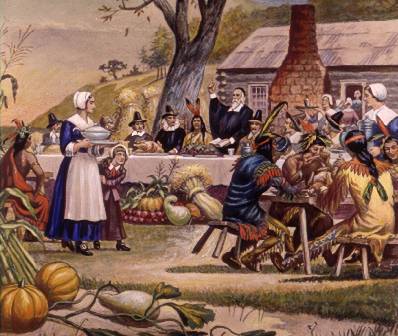
What, to the Native American, is Thanksgiving?
In 1852, Frederick Douglas was asked to speak at a convention in Rochester, NY to commemorate the 4th of July. At this point, the ownership and mistreatment of slaves was still accepted throughout the United States.
Douglass’ speech, “What to the American Slave, is the 4th of July” was a brief but well-reasoned rebuke against the (lack of) logic of asking him to speak. Pointing out the hypocrisy of American independence day, Douglass said:
Your high independence only reveals the immeasurable distance between us. The blessings in which you, this day, rejoice are not enjoyed in common. The rich inheritance of justice, liberty, prosperity, and independence bequeathed by your fathers is shared by you, not by me. The sunlight that brought light and healing to you has brought stripes and death to me. This Fourth of July is yours, not mine.
I wonder if Native Americans feel the same way about Thanksgiving. The revisionist history of Thanksgiving is that we Europeans jumped off the boat and were graciously welcomed by America’s original inhabitants so everyone shared a massive feast to commemorate their great partnership in this great country.
We now know that this story is entirely false. In reality, Europeans stole their land, and massacred the vast majority of the Native American population. The discrimination of America’s native population was official government policy for the vast majority of our history, just as slavery and racial segregation was official U.S. policy for more than two hundred years. And we have yet to repent properly.
So what, to the Native American, is Thanksgiving? It is a farce that highlights the government’s selective amnesia in its darkest hours. It is a mockery of the beautiful and well-maintained land that was stolen in return for the dusty reservations that white people did not want.
Thanksgiving should make us think about what we are thankful for. But it should also make us think about our failings and how we can improve upon them. And I would like to see a more whole-hearted attempt by the United States government to apologize for its original sins of slavery and Native American relocation, even if this attempt is only in the form of words.
That would finally make days like the 4th of July and Thanksgiving fully inclusive holidays that represent national cohesion rather than ignore past oppression.
Gay Rights for the 21st Century
Jonathan Rauch of The Advocate writes about the gay rights agenda in an Obama-Biden world, which is more accepting of minorities and oppressed populations than, well, the Bush-Cheney world.
He cites Hillary Clinton’s concession speech as an example of the United State’s new accepting stance towards gay rights. Each mention of extending equity to gays and lesbians was met with thunderous applause, and mostly from young people. The gay cause is now a rallying-cry for the Democratic Party's liberal base, not an ashamed aside. And when my generation is in charge, the right wing’s homophobic agenda will be a fringe issue, not the norm for the Republican Party.
(Clearly we aren’t yet an entirely accepting nation, which is proven by the anti-gay marriage amendments passed this month in California, Arizona and Florida. But we are definitely moving that way.)
So Rauch presents the necessity to alter gay advocacy for our more accepting times. He writes, “the time has come to pivot away from the culturally defensive pariah agenda -- the Employment Non-Discrimination Act, for instance -- and toward the culturally transformative family agenda.” Andrew Sullivan calls this “Gay Rights 3.0”.
Moving towards a more culturally transformative approach is smart because we are going in that direction just by virtue of progress. So it makes sense for the gay rights movement to evolve to reflect those changes, as Rauch suggests.
True acceptance of homosexuals might take a little while, but it will happen. We just need to wait for people to grow up a little bit, both literally and symbolically.
He cites Hillary Clinton’s concession speech as an example of the United State’s new accepting stance towards gay rights. Each mention of extending equity to gays and lesbians was met with thunderous applause, and mostly from young people. The gay cause is now a rallying-cry for the Democratic Party's liberal base, not an ashamed aside. And when my generation is in charge, the right wing’s homophobic agenda will be a fringe issue, not the norm for the Republican Party.
(Clearly we aren’t yet an entirely accepting nation, which is proven by the anti-gay marriage amendments passed this month in California, Arizona and Florida. But we are definitely moving that way.)
So Rauch presents the necessity to alter gay advocacy for our more accepting times. He writes, “the time has come to pivot away from the culturally defensive pariah agenda -- the Employment Non-Discrimination Act, for instance -- and toward the culturally transformative family agenda.” Andrew Sullivan calls this “Gay Rights 3.0”.
Moving towards a more culturally transformative approach is smart because we are going in that direction just by virtue of progress. So it makes sense for the gay rights movement to evolve to reflect those changes, as Rauch suggests.
True acceptance of homosexuals might take a little while, but it will happen. We just need to wait for people to grow up a little bit, both literally and symbolically.
Congo - Interview

Speigel Online has published an interview with Vital Kamerhe, the president of the National Assembly for the Democratic Republic of the Congo. To me, the most poignant section is when he is asked about Luarent Nkunda’s mission of protecting the Tutsis. Kamerhe responds, “Today we have Tutsi generals in the Congolese army and Tutsi workers at state enterprises. Their best source of protection are the institutions of the Republic, not a rebel army.” Kamerhe also speaks of the need for talks between the government and the rebel army. Nkunda has refused repeated requests to meet with the DRC government.
Unfortunately, it seems to me like the rebel army’s fight is not so much with the DRC government, but more with the Hutu genocide perpetrators who fled to the rural areas of the DRC after Rwanda’s genocide. So anything short of helping Nkunda’s army round up the alleged perpetrators might not appease the rebels.
Also, Sarah pointed out this story (with video and photos) on the front page of CNN yesterday.
Interview Transcript:
Unfortunately, it seems to me like the rebel army’s fight is not so much with the DRC government, but more with the Hutu genocide perpetrators who fled to the rural areas of the DRC after Rwanda’s genocide. So anything short of helping Nkunda’s army round up the alleged perpetrators might not appease the rebels.
Also, Sarah pointed out this story (with video and photos) on the front page of CNN yesterday.
Interview Transcript:
SPIEGEL: Why hasn't your government succeeded in bringing peace to the eastern part of the Democratic Republic of Congo?
Vital Kamerhe: After the peace agreement of 2002 the rebel organizations were absorbed into the army. Because of this, our troops now consist of regular soldiers as well as former militia members. The army is fragile and frustrated, and it has been infiltrated. It makes it difficult to enforce peace.
SPIEGEL: The soldiers are attacking civilians, plundering, and raping.
Kamerhe: Anyone responsible for massacres belongs in front of an international court. Because of the war in the east, we have had no time to reform our security forces or justice system.
SPIEGEL: Rebel leader Laurent Nkunda, your main enemy, says he needs to protect the Tutsis in the eastern part of the country from the Hutu-killers who fled to Congo after the genocide in Rwanda in 1994.
Kamerhe: This is just a pretext. Today we have Tutsi generals in the Congolese army and Tutsi workers at state enterprises. Their best source of protection are the institutions of the Republic, not a rebel army.
SPIEGEL: Isn't the war really a fight over natural resources?
Kamerhe: Our country is a special case geologically. We possess valuable minerals like coltan, gold and diamonds. Our natural resources are being exhausted by the Nkunda rebels, who conduct their sales through Rwanda. Big companies in China, Russia, Europe and the US are the recipients. They share the guilt for this exploitation. We prefer that the resources be used legally.
SPIEGEL: The UN Security Council wants to strengthen its 18,000 blue helmet force with 3,000 additional men. Is that enough?
Kamerhe: We need international troops to protect the populace. There also needs to be political talks with Nkunda and diplomatic efforts to restore the relationship between Congo and Rwanda. That will take time. To begin with we hope for an EU-contingent -- 850 men can help stop a humanitarian catastrophe.
Come Together (Right Now!)
Congressional Democrats: Stop acting like children. Martin Kady II of Politico reports today that there will be numerous divisions among the Democrats even if they win the filibuster-proof 60-seat majority. Most likely, after the Minnesota recount and Georgia runoff election, Dems will have 58 or 59 seats, but 60 is still possible.
Regardless, there is a chance that, enjoying a mandate to make a huge impact in the first two years, the Democrats will revert to infighting and squander their opportunity to change. From Politico:
I sincerely hope this is not what the next two years of Democratic control looks like. But I don’t quite trust members of congress to protect against that inevitability. Each Senator and Representative has his or her own constituency that they (understandably) need to look out for and will therefore continue to pursue pet issues.
So it is important for Democrat-in-Chief Barack Obama to lay out a clear Congressional agenda for Democrats to unite behind. That agenda should include:
1.) Passing a massive and efficient economic stimulus plan.
2.) Reforming the health care system with Universal Health Care as the ideal.
3.) Starting to bring troops home from Iraq. Remember Iraq?
I would also put broadening environmental policy on that list, but that could be a hard-fought battle within the Democratic Party between environmental champions like Henry Waxman and Barbara Boxer (both from California) and pro-labor, business-focused Democrats like Evan Bayh (Indiana), Sherrod Brown (Ohio), and Debbie Stabenow (Michigan). Though both sides are looking out for important goals, those objectives will directly clash in this case.
So in order to get something done and maintain the Democratic control of Washington in 2010 and 2012, Democrats need to stick to the basics and what they can agree on early: Economic stimulus, health care reform, and stopping the war in Iraq.
Regardless, there is a chance that, enjoying a mandate to make a huge impact in the first two years, the Democrats will revert to infighting and squander their opportunity to change. From Politico:
Unless Senate Majority Leader Harry Reid (D-Nev.) and House Speaker Nancy Pelosi (D-Calif.) can whip their caucuses into unity, numerous fault lines will be revealed: Southern Democrats vs. Northern liberals on labor law; California greens vs. Rust Belt Democrats on global warming; socialized medicine adherents vs. go-slow health care reformers; anti-war liberals vs. cautious centrists on national security. And don’t forget the anti-bailout crowd vs. the powerful Michigan Democrats in both chambers when it comes to money for Detroit.
I sincerely hope this is not what the next two years of Democratic control looks like. But I don’t quite trust members of congress to protect against that inevitability. Each Senator and Representative has his or her own constituency that they (understandably) need to look out for and will therefore continue to pursue pet issues.
So it is important for Democrat-in-Chief Barack Obama to lay out a clear Congressional agenda for Democrats to unite behind. That agenda should include:
1.) Passing a massive and efficient economic stimulus plan.
2.) Reforming the health care system with Universal Health Care as the ideal.
3.) Starting to bring troops home from Iraq. Remember Iraq?
I would also put broadening environmental policy on that list, but that could be a hard-fought battle within the Democratic Party between environmental champions like Henry Waxman and Barbara Boxer (both from California) and pro-labor, business-focused Democrats like Evan Bayh (Indiana), Sherrod Brown (Ohio), and Debbie Stabenow (Michigan). Though both sides are looking out for important goals, those objectives will directly clash in this case.
So in order to get something done and maintain the Democratic control of Washington in 2010 and 2012, Democrats need to stick to the basics and what they can agree on early: Economic stimulus, health care reform, and stopping the war in Iraq.
Help Wanted: Vision, Experience, Clout

The new Obama administration has promised to change Washington. Whether they succeed in changing the bitter partisanship and menial bureaucracy, one thing is sure: the group of Senate Democrats will change a great deal.
For the past four years, Barack Obama, Hillary Clinton and Joe Biden have been three of the most prominent Democratic voices and critics of George W. Bush in Washington. They have all stood out for different reasons.
Obama, the charismatic and sole African American in the Senate has been lauded since his 2004 speech at the Democratic National Convention as the Democratic Party’s next Visionary. Joe Biden has been a Senator from Delaware for 36 years. He, along with Edward Kennedy of Massachusetts (though Biden to a lesser extent) is one of the party’s most consistent progressive voices. Holding stints as chairman of the Senate’s Judiciary and Foreign Affairs committees, he is one of his Party’s most experienced leaders. Hillary Clinton has been an outstanding, though moderate, Senator from New York for the past six years. And as the former First Lady, Clinton has more clout in Washington than most of her Democratic colleagues.
So as Obama, Biden and Clinton begin their new roles as President, Vice President, and Secretary of State (rumored), Senate Democrats will begin the search for replacements for these candidates. And that is a difficult undertaking.
Barack Obama, Illinois
Illinois Governor Rod R. Blagojevich (D) must choose Obama’s replacement. And since Obama has already resigned his seat, the pressure has begun for the second-term governor.
There are a lot of factors to consider. First, as holds true for all of these replacements, Governors must choose a candidate who would be a strong contender for reelection in only 2 years – all three Senate replacements will face Republican challengers in 2010. So Blagojevich should not choose a political neophyte who could appear vulnerable to the Illinois GOP.
There are also demographic concerns. Obama, as the Senate’s only African American, occupies an essential seat. His election as President, a momentous occasion for African Americans, once again made the U.S. Senate 0% black. So should Blagojevich appoint an African-American replacement? If he chooses to, then Jesse Jackson Jr. would be the obvious choice. Jackson Jr. represents an urban area including Chicago’s south suburbs in the Illinois House of Representatives. Though he holds high favorability ratings, it is reported that Blagojevich and Chicago’s six-term mayor Richard M. Daley do not like him.
I’m hoping that Jackson gets appointed because, though it is not the only or most important qualification, I think it is imperative that we maintain an African American presence in the Senate. Even if that presence is negligible, it sets a foundation that will undoubtedly strengthen before long.
The other leading contender for Obama’s seat is Tammy Duckworth, an Iraq war veteran and Illinois Veterans Affairs Director who is a close Obama ally. Duckworth is an Asian American and would add an invaluable minority and female voice to the Senate. From what I can tell, both Jackson Jr. and Duckworth are incredibly worthy of Obama’s seat.
Joe Biden, Delaware
Joe Biden has held this seat for 36 years, since he was 30 years old. The only way that Biden could have lost this seat was to give it up himself or by some tragedy. But with Biden’s election as Vice President, current governor Ruth Ann Minner or Governor-elect Jack Markell – both Democrats – will be charged with filling this legendary seat.
The immediate front-runner was Biden’s son Beau, the state’s current Attorney General. But Beau Biden has recently said that he would not accept the position if appointed because he must fulfill his commitment to a yearlong tour in Iraq.
So likely choices are the state’s Lieutenant Governor John Carney, Secretary of State Harriet Windsor, and Supreme Court Chief Justice Myron Steele. As these candidates are relatively unknown, I’d expect the Delware GOP to mount an all-out offensive for this seat in 2010.
Hillary Clinton, New York
Keep in mind, Clinton has not yet formally accepted Barack’s nomination for Secretary of State. And that nomination has not yet been formally given. This is also interesting because if she does not accept the nomination, she could probably hold this Senate seat for life. But being a Clinton means you seek the highest position possible when it is offered. And service is not an option. I think that Hillary will definitely accept both out of ambition and out of duty.
New York Governor David Patterson will choose her replacement if she accepts the nomination. There are anywhere between 10-20 possible selections for this seat. Patterson has vowed that he would not appoint himself, as he hopes to seek re-election for Governor in 2010.
The leading contender is Andrew Cuomo, the New York Attorney General. In a nearly worthless poll, 43% of New Yorkers said that they would prefer Mr. Cuomo. 42% were unsure, and the remainder – 15% - were split between state reps Nydia M. Velázquez, Steve Israel, Nita M. Lowey and Gregory W. Meeks. Update: Chris Cilliza of Washington Post lists the probabilities of each potential NY candidate.
This is the seat that I am most excited to see filled because the list of potential Clinton replacements is incredibly diverse, including women, African Americans, Latino Americans, and of course, white men. Patterson could go with the safe, and likely smart choice, Andrew Cuomo, or a risky and dynamic unknown future Senator.
The Power of Vision
By virtue of filling powerful senate seats with new appointments, experience and clout is difficult to replicate. But vision can certainly be reintroduced. Remember, Barack Obama was elected to the Senate only four years ago. And he has already become one of the greatest American visionaries of the past half-century.
So I hope that Governors Blagojevich (IL), Minner (DE) and Patterson (NY) will appoint exciting candidates that will bring powerful visions to the Senate. Such vision could have three results. 1.) Vision can inspire a massive movement; 2.) Vision can turn into steady and effective governance, and therefore translate to experience; and 3.) a powerful Vision can create the clout needed to usher in a new post-partisan era in Washington.
Jimmy Carter Denied Zimbabwe Visa
 Zimbabwe's dictator Robert Mugabe has just forbidden a winner of the Nobel Peace Prize from entering his country. I'd say that sends a message. Carter was going to visit on a humanitarian mission with former UN Secretary General Kofi Annan and former South African President Nelson Mandela, also a Nobel Peace Prize winner.
This is an indication of Mugabe's contempt for peace and a "measure of the Zimbabwean leader’s disdain for international opinion at a time when deepening hunger, raging hyperinflation and the collapse of health, sanitation and education services have crippled Zimbabwe."
Can't Make This Up
This is hilarious. Palin completes an interview while Turkeys are brutally killed behind her. It is like something out of a National Lampoon's Family Vacation movie. I think it gets best around minute 2:30.
Looking Bleak
The National Intellegence Council has predicted what the world will look like for the U.S. in 2025. And some of the predictions look pretty intimidating. Highlighted by the Daily Kos:
At least we will still have 50 states. But Kos also reports that the NIC did another report four years ago that was much more optimistic. I shudder to think about what the 2012 predictions will look like.
U.S. economic and political clout will decline over the next two decades and the world will be more dangerous, with food and water scarce and advanced weapons plentiful, U.S. spy agencies projected on Thursday. ...
The U.S. dollar's role as the world's major currency would weaken to become a "first among equals," the report said. ...
A world with multiple power centers has been less stable than one with a single or two rival superpowers, and there was a growing potential for conflict, the report said.
Global warming will be felt, and water, food and energy constraints may fuel conflict over resources.
At least we will still have 50 states. But Kos also reports that the NIC did another report four years ago that was much more optimistic. I shudder to think about what the 2012 predictions will look like.
Today's Dumbest Argument (so far)
The Wall Street Journal argues that Representative Henry Waxman (D-California) replaced Representative John Dingell (D- Michigan) as Chairman of the Energy and Commerce Committee because “Ms. Pelosi loathes Mr. Dingell's independence -- especially on environmental matters.”
Also, Waxman only promotes environmentally responsible policies because he speaks “for the upscale precincts of Beverly Hills.”
Also, Waxman only promotes environmentally responsible policies because he speaks “for the upscale precincts of Beverly Hills.”
The Trouble with Compromise
I remember growing up learning that compromise was the greatest virtue. At home I learned to share; at school I learned about Henry Clay (“The Great Compromiser”) and the Missouri Compromise.
Christina (co-worker) and I were just talking about bailing out the auto industry. We distilled two ways for the auto industry to get back on track.
1.) The market will correct itself. If the Big Three files for bankruptcy, then an external investor will intervene to reinvent the company and make it work better
2.) The government can bail out the Big Three under the conditions of improving operations and making more efficient cars.
I favor the government approach because it will ensure that labor is protected and will put environment as a priority. In general, government wants to protect people and business wants to protect business. And I prefer people to business. (I’m forgetting for the moment that businesses are made up of and therefore protect people.)
When it comes to a government-supervised reconstruction of the auto industry, critics are likely correct: The government won’t do a good job. If the left (or right) has a good idea about how to do it, then they will have to bend over backwards to compromise to get a restructuring program through congress. This compromise will undoubtedly make the program close-to-worthless.
What starts with good intentions ends with good legislation, which is bad in practice.
Why can’t democrats win 100 Senate seats?
Christina (co-worker) and I were just talking about bailing out the auto industry. We distilled two ways for the auto industry to get back on track.
1.) The market will correct itself. If the Big Three files for bankruptcy, then an external investor will intervene to reinvent the company and make it work better
2.) The government can bail out the Big Three under the conditions of improving operations and making more efficient cars.
I favor the government approach because it will ensure that labor is protected and will put environment as a priority. In general, government wants to protect people and business wants to protect business. And I prefer people to business. (I’m forgetting for the moment that businesses are made up of and therefore protect people.)
When it comes to a government-supervised reconstruction of the auto industry, critics are likely correct: The government won’t do a good job. If the left (or right) has a good idea about how to do it, then they will have to bend over backwards to compromise to get a restructuring program through congress. This compromise will undoubtedly make the program close-to-worthless.
What starts with good intentions ends with good legislation, which is bad in practice.
Why can’t democrats win 100 Senate seats?
Women!

Yes, Eric, Hillary Clinton is a woman. But she has not been appointed yet, so I did not count it.
Obama will reportedly appoint Arizona Governor Janet Napolitano (pictured above) to lead the Department of Homeland Security. It sounds like a really great fit for her and a cool choice from the Obama administration due to her success in immigration. It's a little unfortunate because Napolitano was expected to be a strong challenger for John McCain's senate seat in 2010. But a cabinet position would be a huge political boost for her as well.
Obama was also courting Penny Pritzker, the Chicago businesswoman of hyatt-fame, for Secretary of Commerce, but it looks like she has taken her name out of contention.
With Holder, Napilitano and Clinton (and some other white guys) potentially in powerful positions, it looks like Obama's cabinet could be truly diverse.
Etc...
Some items I have not weighed in on.
Lieberman
The Dems had to keep him in the caucus. Cutting him out would have sent a terrible message that breaking party lines is unacceptable. On the other hand, Sarah was saying last week that the problem with Lieberman was not that he supported McCain, but the way in which he did it. He said some pretty awful things about Obama’s “Marxist” views and ties to objectionable people. But either way, I’m glad they kept him in the caucus because I just don’t care about him too much. Let him keep the chairmanships that he has earned. But don’t let the man get any more powerful. He’s just not worth that much thought.
Clinton as Secretary of State
The idea of this has grown on me a lot. I still think that Bill Richardson would do an incredible job, but Clinton really could be well suited for the role. As First Lady, she has already visited many international countries and met with world leaders. This would give her a familiarity that could be valuable on the world stage.
Still, I don’t understand why she would want the job. As I wrote before, she would be giving up a Senate seat for life for what is most likely a 4 year job. It’s not likely that she is trying to beef up her foreign policy credentials to challenge Barack in 2012, and she would probably be too old to run in 2016. For those reasons, it seems like Hillary as Secretary of State is a better option for the U.S. than it is for her and anyway, she seems to have her own reservations.
Is anyone else wondering when Barack is going to appoint a woman to something?
I initially thought he'd appoint Janet Napolitano Attorney General, but it looks like that position is going to Eric Holder.
Lieberman
The Dems had to keep him in the caucus. Cutting him out would have sent a terrible message that breaking party lines is unacceptable. On the other hand, Sarah was saying last week that the problem with Lieberman was not that he supported McCain, but the way in which he did it. He said some pretty awful things about Obama’s “Marxist” views and ties to objectionable people. But either way, I’m glad they kept him in the caucus because I just don’t care about him too much. Let him keep the chairmanships that he has earned. But don’t let the man get any more powerful. He’s just not worth that much thought.
Clinton as Secretary of State
The idea of this has grown on me a lot. I still think that Bill Richardson would do an incredible job, but Clinton really could be well suited for the role. As First Lady, she has already visited many international countries and met with world leaders. This would give her a familiarity that could be valuable on the world stage.
Still, I don’t understand why she would want the job. As I wrote before, she would be giving up a Senate seat for life for what is most likely a 4 year job. It’s not likely that she is trying to beef up her foreign policy credentials to challenge Barack in 2012, and she would probably be too old to run in 2016. For those reasons, it seems like Hillary as Secretary of State is a better option for the U.S. than it is for her and anyway, she seems to have her own reservations.
Is anyone else wondering when Barack is going to appoint a woman to something?
I initially thought he'd appoint Janet Napolitano Attorney General, but it looks like that position is going to Eric Holder.
The Continuing Congo Crisis

Though the crisis in the Democratic Republic of the Congo has not been front and center in major media outlets, some sources have written very powerfully on the subject. BBC on the UN’s involvement in the Congo; Washington Post on the devastating destruction of the rebel militias; New York Times on the Congo’s natural resources and how they fuel the fighting; most poignantly, Slate on the western world’s refusal to help significantly even after the collective guilt inspired by not doing something in Rwanda in 1994.
A little background:
The 1994 Rwandan genocide was a direct result of this pre-independence ethnic favoritism; the Hutu majority (making up nearly 85% of the population) violently and maliciously rose up against the Tutsi leadership with devastating results. By most estimates, 800,000 Tutsis and moderate Hutus were murdered in the 100 days of the Rwandan genocide.
Since the genocide, the Tutsis have retained control of the government, forcing ethnically biased policies on the population. The government’s treatment of the country’s Hutu population – perpetrator and innocent alike – prompted many Hutus to flee to the mountainous region of the Congo, afraid of further government retaliation. This resulted in a series of wars between 1998-2003, the aftermath of which (still being felt today) were responsible for more than 5 million deaths.
More recently, the Tutsi rebel leader Laurent Nkunda has organized militias to protect the DRC’s Tutsi population from the Hutu genocidaires who fled to the DRC after the genocide in 1994 to avoid prosecution for their crimes.
What it means
The central problem plaguing Rwanda and the DRC is the lack of a moderate government. Only in 2006, the DRC inaugurated its first democratically elected government. Before that, its leadership had been dictated by military coups and ethnically charged ideologues. The country’s Tutsi population is statistically insignificant and feels that it cannot impact the government democratically, which some say is the reason for the rise of Laurant Nkunda’s rebel army.
This is all important because many sources say that Nkunda’s rebel army might be associated with the Tutsi-dominated Rwandan government. Nkunda famously calls himself the "Savior of the Tutsis" and his fighting under the supervision of the Rwandan government would surely cause a regional war between Rwanda, the DRC and many other Central African nations, based not only on governmental sovereignty but potentially on the same ethos that drove the ethnic wars of the last 15 years.
The international community must intervene before it is too late. Yes, the United Nations has been working hard in the Congo. But you would think that nearly 5.5 million deaths would require a major international presence in the country to work towards ending the war permanently.
Citing the West’s failure to act in the 1994 genocide, Michael Kavanagh presents this necessity very clearly:
Failing to act would mean adding the DRC to a list, including Rwanda and Sudan, of countries we don’t consider worth helping despite massive crises.
A little background:
The 1994 Rwandan genocide was a direct result of this pre-independence ethnic favoritism; the Hutu majority (making up nearly 85% of the population) violently and maliciously rose up against the Tutsi leadership with devastating results. By most estimates, 800,000 Tutsis and moderate Hutus were murdered in the 100 days of the Rwandan genocide.
Since the genocide, the Tutsis have retained control of the government, forcing ethnically biased policies on the population. The government’s treatment of the country’s Hutu population – perpetrator and innocent alike – prompted many Hutus to flee to the mountainous region of the Congo, afraid of further government retaliation. This resulted in a series of wars between 1998-2003, the aftermath of which (still being felt today) were responsible for more than 5 million deaths.
More recently, the Tutsi rebel leader Laurent Nkunda has organized militias to protect the DRC’s Tutsi population from the Hutu genocidaires who fled to the DRC after the genocide in 1994 to avoid prosecution for their crimes.
What it means
The central problem plaguing Rwanda and the DRC is the lack of a moderate government. Only in 2006, the DRC inaugurated its first democratically elected government. Before that, its leadership had been dictated by military coups and ethnically charged ideologues. The country’s Tutsi population is statistically insignificant and feels that it cannot impact the government democratically, which some say is the reason for the rise of Laurant Nkunda’s rebel army.
This is all important because many sources say that Nkunda’s rebel army might be associated with the Tutsi-dominated Rwandan government. Nkunda famously calls himself the "Savior of the Tutsis" and his fighting under the supervision of the Rwandan government would surely cause a regional war between Rwanda, the DRC and many other Central African nations, based not only on governmental sovereignty but potentially on the same ethos that drove the ethnic wars of the last 15 years.
The international community must intervene before it is too late. Yes, the United Nations has been working hard in the Congo. But you would think that nearly 5.5 million deaths would require a major international presence in the country to work towards ending the war permanently.
Citing the West’s failure to act in the 1994 genocide, Michael Kavanagh presents this necessity very clearly:
Over the years, many world leaders have made the trip to Rwanda to stand before the gravesites of genocide victims and apologize for their inaction in 1994. But if the worth of an apology is measured not in words but in actions, most of these apologies have been rubbish. True repentance for Rwanda has always meant ending the Congolese conflict—especially in the Kivus.
Failing to act would mean adding the DRC to a list, including Rwanda and Sudan, of countries we don’t consider worth helping despite massive crises.
An Auto Bailout? The Government Must Protect
About a month after a bailout that did not do much good, the American government is considering bailing out another essential sector of the American economy: the Detroit-based automobile industry. It seems like everyone opposes the auto bailout. Many progressives see the industry’s failure as a referendum on their unflinching alliance with gas guzzling SUVs and refusal to convert to more environmentally conscious vehicles like the automobile industries of Japan, China, and South Korea. Conservatives are weary of more government intervention in an already heavy regulatory year and an assault to fiscal conservatism.
The auto bailout makes me uncomfortable for a variety of reasons. First, as mentioned above, the failures of American automobile companies are largely their fault. Second, the continuing stream of government bailouts raises larger questions of which industries are valuable enough to protect. And are we truly a capitalist society if we ditch the dogma when times get tough? Aren’t we supposed to let the market correct itself?
This is the problem with rigid economic ideologies. In an ideal capitalist state, we would let the failing companies declare bankruptcy so that they would either be forced to improve operations or allow a better company to fill their place.
But a government cannot work that way. A government must protect its people, and that means ensuring that banks are operational and can continue to give loans, and that a country’s largest industries can continue to employ their workers.
Jonathan Cohn of The New Republic has written on the many reasons that the U.S. government should bail out the automobile industries. His most persuasive argument comes at the end. By bailing out the auto companies, the U.S. government would be in an ideal position to enforce conditions that would make the companies more efficient, both economically and environmentally.
I think that as much as it pains us to admit it, Cohn is correct: we must bail out the automobile industry. Letting it fail would be too devastating in this economy.
But the larger issue here concerns the ideology that drives the American economy. The bailouts of the past few months – suggested by a Republican President – have made a mockery of fiscal conservatives and should usher in an era of more responsible governance.
A country’s economy is only as good as its reaction to a crisis. And the current meltdown has proven that fiscal conservatism is not adequate. We need big government to prevent big problems. I’d trade slightly limited short-term growth for consistent long-term growth any day.
In the past few months, I have come to equate the economy of the past eight years to an overgrown lawn. Yes, all of the weeds are growing very well but who is going to mow the lawn and pull the weeds when it gets out of hand?
I’ll be interested to see if small government conservatives forget this period of absolutely necessary government intervention when the economy gets good again. My guess is that their ideology has made conservatives short-sighted enough to forget the lesson and refocus on their creed.
The auto bailout makes me uncomfortable for a variety of reasons. First, as mentioned above, the failures of American automobile companies are largely their fault. Second, the continuing stream of government bailouts raises larger questions of which industries are valuable enough to protect. And are we truly a capitalist society if we ditch the dogma when times get tough? Aren’t we supposed to let the market correct itself?
This is the problem with rigid economic ideologies. In an ideal capitalist state, we would let the failing companies declare bankruptcy so that they would either be forced to improve operations or allow a better company to fill their place.
But a government cannot work that way. A government must protect its people, and that means ensuring that banks are operational and can continue to give loans, and that a country’s largest industries can continue to employ their workers.
Jonathan Cohn of The New Republic has written on the many reasons that the U.S. government should bail out the automobile industries. His most persuasive argument comes at the end. By bailing out the auto companies, the U.S. government would be in an ideal position to enforce conditions that would make the companies more efficient, both economically and environmentally.
Those conditions would include limits on executive compensation, as in the Wall Street rescue, but also more specific requirements designed to push the Big Three toward greater innovation and fuel efficiency.
I think that as much as it pains us to admit it, Cohn is correct: we must bail out the automobile industry. Letting it fail would be too devastating in this economy.
But the larger issue here concerns the ideology that drives the American economy. The bailouts of the past few months – suggested by a Republican President – have made a mockery of fiscal conservatives and should usher in an era of more responsible governance.
A country’s economy is only as good as its reaction to a crisis. And the current meltdown has proven that fiscal conservatism is not adequate. We need big government to prevent big problems. I’d trade slightly limited short-term growth for consistent long-term growth any day.
In the past few months, I have come to equate the economy of the past eight years to an overgrown lawn. Yes, all of the weeds are growing very well but who is going to mow the lawn and pull the weeds when it gets out of hand?
I’ll be interested to see if small government conservatives forget this period of absolutely necessary government intervention when the economy gets good again. My guess is that their ideology has made conservatives short-sighted enough to forget the lesson and refocus on their creed.
Barack Offers Hillary Secretary of State?

Huffington Post reports that President-elect Barack Obama has offered Senator Hillary Clinton the Secretary of State position.
This seems like such an odd choice for both Barack Obama and Hillary Clinton. For Barack, he is appointing a foe to one of the most important cabinet positions. And why, as Josh Marshall asked a few days ago, would Clinton give up what is probably a Senate seat for life? Could she be setting herself up for a campaign for President in 2012 or 2016? Marshall doubts that:
That strikes me as deeply, deeply improbable. Never an easy thing to challenge a sitting president of your own party, next to impossible to do it from his own cabinet. I don't have an answer on why either party would want this appointment. But that ain't the reason.
I have a few thoughts. First, this could be an empty olive branch. Barack might have offered Hillary the position knowing that she would not accept in an early attempt to unify the Democratic party before he is inaugurated. Second, Barack could be genuine about his desire to surround himself with a cabinet and advisors who will challenge his actions. Hillary would certainly be that.
Of course, keep in mind that this has not been substantiated by a solid newspaper. But Huffington Post is typically pretty accurate.
UPDATE: Barack Obama also meets with Governor Bill Richardson about the Secy of State job.
Of course, keep in mind that this has not been substantiated by a solid newspaper. But Huffington Post is typically pretty accurate.
UPDATE: Barack Obama also meets with Governor Bill Richardson about the Secy of State job.
The Racial Context of Prop 8

Since election day, there have been numerous articles about the black vote's impact on Proposition 8. According to exit polls, 70% of African Americans voted for Prop 8. Somehow the blame for this hateful piece of legislation was not directed to the Mormon Church, which lobbied vigorously for the Proposition, but to Black Californians, who constitute less than ten percent of the electorate.
It certainly is an interesting issue. Why do African Americans, potentially the most oppressed group in history, oppose extending civil liberties to another minority group: homosexuals? Below is one explanation from Slate.
They think sexual orientation is different from race. Martin Luther King Jr. spoke of a nation in which individuals would be judged not "by the color of their skin but by the content of their character." Whites, on balance, have come to believe that sexual orientation, like color, is immutable. Blacks, on balance, haven't. They see homosexuality as a matter of character. "I was born black. I can't change that," one California man explained after voting for Proposition 8. "They weren't born gay; they chose it."
These examples prompted a slew of criticism about the Black community's impact on Prop 8. Gay activist Dan Savage said that African Americans are a bigger threat to homosexuals than racists are to African Americans. Even though it appears that blacks had a disproportionate impact on the result, those criticisms are misguided and highlight some disturbing sentiments. Unsure who to blame, we accuse another marginalized minority thereby precipitating a race to the bottom.
The appropriate question is Why do African Americans overwhelmingly oppose gay marriage? In the African American web journal The Root, Kai Wright writes that this is primarily the fault of the gay rights movement. In an attempt to streamline their message, gay rights activists have sidelined the black community. Wright acknowledges the conundrum facing African Americans and Prop 8, saying that their impact on the proposition "ought to shame black folks everywhere." But Wright continues to say that the gay rights movement has been self-serving in the past, using black experience only when it was convenient.
Many black folks wince when they hear gay rights compared to the black civil rights movement. And when it comes from white gays whose only interest in black people is appropriating our history, I do too.
When it comes down to it, guaranteeing civil liberties to a wider cross-section of Americans will benefit all minorities and strengthen the country. We are only as good as what we accept, and we wont be much of anything so long as we deny the right for men and women to love who they want. So let's focus on the fact that more than 50% of California's population - white, black, gay, straight - voted for Proposition 8. Let's stop the blame game.
Star Search
I have to say, Palin has been doing a pretty good job changing her image in the past couple weeks. Today she headlined the Republican Governors' Convention, she has sat for multiple interviews on FOX News and CNN, and she is even clearing the record about the false accusations about her on the campaign trail. Yes, she is still saying some crazy things (continuing to raise questions about Obama’s associations) but that trait is inextricably tied to her character. All in all, Palin is improving her image.
This article writes about Palin’s long-term goals and the potential for running in 2012. But it also discusses other future major players in the Republican Party. These include young governors like Bobby Jindal (LA) and Tim Pawlenty (MN). Both of these Governors (and Palin too) could be major threats to the Democratic Mandate that was secured in last week’s election.
Since they are young and relatively new to the national scene, they could really stand for change, not just of the Republican Party, but also of the United States Government. Pawlenty from the article linked above:
He seems like a guy who has taken a hard look at his Party and has some real solutions to make it competitive again. With guys like Pawlenty at the helm of the GOP, I fear that their soul searching might not take as long as I initially expected.
This article writes about Palin’s long-term goals and the potential for running in 2012. But it also discusses other future major players in the Republican Party. These include young governors like Bobby Jindal (LA) and Tim Pawlenty (MN). Both of these Governors (and Palin too) could be major threats to the Democratic Mandate that was secured in last week’s election.
Since they are young and relatively new to the national scene, they could really stand for change, not just of the Republican Party, but also of the United States Government. Pawlenty from the article linked above:
“We cannot be a majority governing party when we essentially cannot compete in the Northeast, we are losing our ability to compete in Great Lakes States, we cannot compete on the West Coast, we are increasingly in danger of competing in the Mid-Atlantic States, and the Democrats are now winning some of the Western States,” he said. “That is not a formula for being a majority governing party in this nation.”
“And similarly we cannot compete, and prevail, as a majority governing party if we have a significant deficit, as we do, with women, where we have a large deficit with Hispanics, where we have a large deficit with African-American voters, where we have a large deficit with people of modest incomes and modest financial circumstances,” he said. “Those are not factors that make up a formula for success going forward.”
“There will be calls, and voices across the country for Republicans to return to traditional conservative approaches in almost all respects,” he said, adding that there would also be calls to modernize the party.
“The good news is both are true, and both can be harmonized in my view,” Mr. Pawlenty said. “We can be both conservative and we can be modern at the same time.”
He seems like a guy who has taken a hard look at his Party and has some real solutions to make it competitive again. With guys like Pawlenty at the helm of the GOP, I fear that their soul searching might not take as long as I initially expected.
I Solved Gay Marriage
I’ve heard opponents of gay marriage qualify their opposition by saying that allowing marriage for homosexuals could be the beginning of a slippery slope that results in the complete collapse of the institution. This means allowing marriages of more than two people, or unions between humans and animals. Flipping that assertion around, Dan Savage writes in the Times that acceptance of constitutional bans against gay marriage like those passed last week in California, Florida and Arizona could result in a long list of other hateful policies against America’s minorities.
Savage is right in pointing out this potential. But I actually think that it won’t be long before gay marriage – or some form of it – is accepted in all 50 states for a lot of reasons. First of all, it is the morally right thing to do. No one should tell another person who they are allowed to love and the ways they are allowed to show that love.
This reminds me of a 2003 David Brooks column which questions why Republicans oppose gay marriage. If they claim to be the champions of family values, why do they refuse to let homosexuals form families? As Brooks writes, “We shouldn't just allow gay marriage. We should insist on gay marriage.”
It is too bad that more Democrats do not outwardly condone gay marriage, though it’s great that so many support civil unions. I think Leigh has the best solution for marriages in the US. The default option – for homos and heteros alike – should be the non-religious civil union. People who want to be united through their church could opt to be married religiously, but enforcing that as U.S. policy only alienates homosexuals.
Savage is right in pointing out this potential. But I actually think that it won’t be long before gay marriage – or some form of it – is accepted in all 50 states for a lot of reasons. First of all, it is the morally right thing to do. No one should tell another person who they are allowed to love and the ways they are allowed to show that love.
This reminds me of a 2003 David Brooks column which questions why Republicans oppose gay marriage. If they claim to be the champions of family values, why do they refuse to let homosexuals form families? As Brooks writes, “We shouldn't just allow gay marriage. We should insist on gay marriage.”
It is too bad that more Democrats do not outwardly condone gay marriage, though it’s great that so many support civil unions. I think Leigh has the best solution for marriages in the US. The default option – for homos and heteros alike – should be the non-religious civil union. People who want to be united through their church could opt to be married religiously, but enforcing that as U.S. policy only alienates homosexuals.
Go Big or Go Home
The New Republic has written an editorial that criticizes those Democrats who urge moderation in the early days of this Democratic mandate. Instead of acting on the promises Obama made in the campaign, the editors write, some Democrats are urging the administration to “replicate the fiscal strategy of the early Clinton era, when the administration scaled back its more ambitious spending plans and focused instead on deficit reduction, a choice that laid the groundwork for the boom of the late 1990s.”
Clearly, the fiscal strategy of the Clinton era is not a bad model to replicate. Especially in the midst of this economic crisis, we need a President who has such economic foresight. But these goals should not replace the agenda laid forth during Obama’s campaign. Voters elected a President who promised to reform health care, reinstitute a graduated tax system, and drastically alter our foreign policy stance in two wars. That is exactly what they should get.
Obama’s goals are certainly risky. If they fail, then the Democrats will undoubtedly lose seats in the 2010 midterm elections and potentially even lose the White House in 2012. But what is the purpose of having power if you are not going to do anything? If you govern as a wimp, effectively doing nothing, then you are going to lose your seat anyway. The Democratic Congress of the past two years is generally considered one of the most gutless majorities ever to control Washington. It appears as if Democrats won more seats than they expected to in 2006 and have governed on an agenda of keeping those seats rather than getting anything done for the past two years.
The Dems can’t keep doing this if they want to maintain control of the White House and Congress. Right now they have a chance to make an enormous impact and change the country for good. If they do anything less than that, then they are going to be voted out in large numbers in 2010 and 2012 because Americans are looking for a permanent solution to our deterioration, not a band aid, run-out-the-clock approach to Bush’s failed policies of the past eight years.
Clearly, the fiscal strategy of the Clinton era is not a bad model to replicate. Especially in the midst of this economic crisis, we need a President who has such economic foresight. But these goals should not replace the agenda laid forth during Obama’s campaign. Voters elected a President who promised to reform health care, reinstitute a graduated tax system, and drastically alter our foreign policy stance in two wars. That is exactly what they should get.
Obama’s goals are certainly risky. If they fail, then the Democrats will undoubtedly lose seats in the 2010 midterm elections and potentially even lose the White House in 2012. But what is the purpose of having power if you are not going to do anything? If you govern as a wimp, effectively doing nothing, then you are going to lose your seat anyway. The Democratic Congress of the past two years is generally considered one of the most gutless majorities ever to control Washington. It appears as if Democrats won more seats than they expected to in 2006 and have governed on an agenda of keeping those seats rather than getting anything done for the past two years.
The Dems can’t keep doing this if they want to maintain control of the White House and Congress. Right now they have a chance to make an enormous impact and change the country for good. If they do anything less than that, then they are going to be voted out in large numbers in 2010 and 2012 because Americans are looking for a permanent solution to our deterioration, not a band aid, run-out-the-clock approach to Bush’s failed policies of the past eight years.
Where to Turn for the GOP?
Last week, after Barack Obama's big win, the question on everyone's mind was, "did the sweeping Democratic blow out amount to a Progressive mandate for America?" Since, the consensus seems to be "yes." Just like the GOP takeover in 1994 or the Democratic wave of 1976, the minority party now has to reinvent itself. In reality, this isn't too much of a big deal. The Democrats didnt fully recover from their lack of message until 2006. Even in 2004, the Democrats could not seem to catch a break, which was emphasized by their constantly fumbling candidate John Kerry.
So we shouldn't expect the Republicans to turn around and immediately have a new message to remake America. That will happen in the aftermath of the upcoming ideological Civil War. In the past few days, a slew of conservative leaders and columnists have been offering advice to their fledgling party.
In the following video produced by TPMtv, David Brooks, maybe my favorite conservative, provides the correct diagnosis for the Republican ailment: they don't stand for anything that matters today. The party that once decried government spending has now held power during the most fiscally inconservative administration since FDR. And social issues (gay marriage, abortion etc...) seem unimportant as the economy crumbles and our place in the world deteriorates. As Brooks says, "It's great to worry about Reagan... but those days are over."
Deroy Murdock (related to Rupert?) seems to have the right idea. The Right needs to get rid of the faction that continues to promote government spending as long as it funds conservative programs. Spending is spending and the government, true conservatives believe, should not interfere too much in American lives. So at the very least, conservatives would benefit from going back to true conservatism.
The other faction of the Repubican Party is already lobbying for a lurch to the right on social issues. Mike Pence (R-IN), soon the third ranking Republican in the House, has said that his party can rebound by embracing an anti-gay, anti-abortion agenda. Honestly, I hope that the GOP will take this path because it will fail as miserably as the fear mongering of the McCain/Palin ticket.
But for now, lets enjoy this progressive mandate. Because before long, the GOP will be back and Democrats will be in the midst of its own identity crisis.
So we shouldn't expect the Republicans to turn around and immediately have a new message to remake America. That will happen in the aftermath of the upcoming ideological Civil War. In the past few days, a slew of conservative leaders and columnists have been offering advice to their fledgling party.
In the following video produced by TPMtv, David Brooks, maybe my favorite conservative, provides the correct diagnosis for the Republican ailment: they don't stand for anything that matters today. The party that once decried government spending has now held power during the most fiscally inconservative administration since FDR. And social issues (gay marriage, abortion etc...) seem unimportant as the economy crumbles and our place in the world deteriorates. As Brooks says, "It's great to worry about Reagan... but those days are over."
Deroy Murdock (related to Rupert?) seems to have the right idea. The Right needs to get rid of the faction that continues to promote government spending as long as it funds conservative programs. Spending is spending and the government, true conservatives believe, should not interfere too much in American lives. So at the very least, conservatives would benefit from going back to true conservatism.
The other faction of the Repubican Party is already lobbying for a lurch to the right on social issues. Mike Pence (R-IN), soon the third ranking Republican in the House, has said that his party can rebound by embracing an anti-gay, anti-abortion agenda. Honestly, I hope that the GOP will take this path because it will fail as miserably as the fear mongering of the McCain/Palin ticket.
But for now, lets enjoy this progressive mandate. Because before long, the GOP will be back and Democrats will be in the midst of its own identity crisis.

Howard Dean Steps Down as DNC Chairman

Dean has certainly been a controversial character in the Democratic Party. He was the grassroots Democratic candidate of 2004, generating overwhelming support from left-leaning blogs. Though Democrats were excited about his unapologetically progressive agenda, it was pretty clear that he would not win the nomination. Still, he bounced back in 2005 to become the Democratic Party chairman.
Dean is best known for his 50-state strategy which has sent representatives of the Democratic Party to all states hoping to reinvent the party everywhere rather than concentrate it along the coasts. This was widely criticized by election-centric Democrats who thought that it would harm chances of winning back Congress in the 2006 midterm elections and the Presidency in 2008. With the massive Democratic wave into Congress in 2006 and Obama’s huge electoral victory, sweeping Pennsylvania, Ohio, Florida, Virginia, North Carolina, New Hampshire, New Mexico, Colorado and Nevada and being competitive in Missouri and Georgia has proven those critics wrong.
But there is still a chance that the 50-state strategy could fade away with Dean. Rahm Emanuel, Obama’s newly minted White House Chief of Staff, is one of the most outspoken critics of the strategy. And despite its success, it is difficult for a major political party to think long-term when an election year is coming up. So we could see the Dems abandon the states in which a Democrat will not be successful in the 2010 midterm elections.
That would be a massive mistake. Even if a Democrat does not win a state he is not expected to, funding his or her campaign gives the candidate more recognition so that he or she could be more competitive the next time around. This incremental increase in recognition could be the key to electoral success in typically red states.
So lets hope that Dean’s Dogma of 50 states becomes the Democratic Dogma so that we can continue to see the party grow and the blue wave sweep across the country to states like Montana, North Dakota, Missouri and Georgia, which were all closer than expected this year, in 2010 and 2012.
Dean is best known for his 50-state strategy which has sent representatives of the Democratic Party to all states hoping to reinvent the party everywhere rather than concentrate it along the coasts. This was widely criticized by election-centric Democrats who thought that it would harm chances of winning back Congress in the 2006 midterm elections and the Presidency in 2008. With the massive Democratic wave into Congress in 2006 and Obama’s huge electoral victory, sweeping Pennsylvania, Ohio, Florida, Virginia, North Carolina, New Hampshire, New Mexico, Colorado and Nevada and being competitive in Missouri and Georgia has proven those critics wrong.
But there is still a chance that the 50-state strategy could fade away with Dean. Rahm Emanuel, Obama’s newly minted White House Chief of Staff, is one of the most outspoken critics of the strategy. And despite its success, it is difficult for a major political party to think long-term when an election year is coming up. So we could see the Dems abandon the states in which a Democrat will not be successful in the 2010 midterm elections.
That would be a massive mistake. Even if a Democrat does not win a state he is not expected to, funding his or her campaign gives the candidate more recognition so that he or she could be more competitive the next time around. This incremental increase in recognition could be the key to electoral success in typically red states.
So lets hope that Dean’s Dogma of 50 states becomes the Democratic Dogma so that we can continue to see the party grow and the blue wave sweep across the country to states like Montana, North Dakota, Missouri and Georgia, which were all closer than expected this year, in 2010 and 2012.
Guantanamo Approach Indicates Out-of-the-Box Mentality
The AP reports today that Barack Obama and other Democrats are seriously considering closing down Guantanamo Bay and looking for creative methods of prosecuting terrorists. Very simply put, they are considering using a "hybrid approach" which would combine some of the aspects of military courts with more of the liberties associated with civilian courts. Republicans oppose this approach because it would bring terrorist suspects to US soil, and Democrats are weary about it because these suspects would not receive all the rights guaranteed for American citizens. For that reason, the plan is constitutionally unstable and, if implemented, would probably require the Supreme Court's attention.
But the fact that the option is on the table says a lot about the future Obama administration. They are willing to look outside the box and consider new methods to overcome some of our country's major failings. Finding a way to hold terrorists accountable without using torture would be a major improvement upon current foreign policy. It is both the morally and politically correct solution to the disgraced facility on Guantanamo Bay. And we will likely see more creative solutions to issues like the economic crisis, alternative energy, and social programs.
But the fact that the option is on the table says a lot about the future Obama administration. They are willing to look outside the box and consider new methods to overcome some of our country's major failings. Finding a way to hold terrorists accountable without using torture would be a major improvement upon current foreign policy. It is both the morally and politically correct solution to the disgraced facility on Guantanamo Bay. And we will likely see more creative solutions to issues like the economic crisis, alternative energy, and social programs.
Map Contest Winnnnnnnner
I'm going to call Missouri and the final electoral vote in Nebraska for McCain so we can declare a winner in this contest. Congratulations Sarah Buchwalter for your overall win! Sarah predicted the electoral vote correctly (364/174) correctly which earned her 15 points, and another five points for guessing 48 of 50 states correctly. Charlie Buchwalter gave her a run for her money, earning 5 points for guessing the third closest electoral vote tally and winning another 10 points for guessing the closest popular vote percentage (He guessed 53/45 and the correct was 53/46).
Congratulations to everyone for competing and maybe you will do better in two years!
Economic Team Announced
Obama has announced his transition team of economic advisors. This is a pretty big deal becuase the economy will definitely be the defining issue of the Obama Presidency.
Among the list are big names like Warren Buffett, Michigan Gov. Jennifer Granholm, Clinton Secretary of the Dept of Labor Robert Reich, Clinton Secretary of the Department of the Treasury Lawrence Summers, and Los Angeles Mayor Antonio Villaraigosa. The entire list is provided below.
The formal announcement will be made tomorrow during a press conference.
Among the list are big names like Warren Buffett, Michigan Gov. Jennifer Granholm, Clinton Secretary of the Dept of Labor Robert Reich, Clinton Secretary of the Department of the Treasury Lawrence Summers, and Los Angeles Mayor Antonio Villaraigosa. The entire list is provided below.
The formal announcement will be made tomorrow during a press conference.
David Bonior (Member House of Representatives 1977-2003)
· Warren Buffett (Chairman and CEO, Berkshire Hathaway)-will participate via speakerphone
· Roel Campos (former SEC Commissioner)
· William Daley (Chairman of the Midwest, JP Morgan Chase; Former Secretary, U.S. Dept of Commerce, 1997-2000)
· William Donaldson (Former Chairman of the SEC 2003-2005)
· Roger Ferguson (President and CEO, TIAA-CREF and former Vice Chairman of the Board of Governors of the Federal Reserve)
· Jennifer Granholm (Governor, State of Michigan)
· Anne Mulcahy (Chairman and CEO, Xerox)
· Richard Parsons (Chairman of the Board, Time Warner)
· Penny Pritzker (CEO, Classic Residence by Hyatt)
· Robert Reich (University of California, Berkeley; Former Secretary, U.S. Dept of Labor, 1993-1997)
· Robert Rubin (Chairman and Director of the Executive Committee, Citigroup; Former Secretary, U.S. Dept of Treasury, 1995-1999)
· Eric Schmidt (Chairman and CEO, Google)
· Lawrence Summers (Harvard University; Managing Director, D.E. Shaw; Former Secretary, U.S. Dept of Treasury, 1999-2001)
· Laura Tyson (Haas School of Business, University of California, Berkeley; Former Chairman, National Economic Council, 1995-1996; Former Chairman, President's Council of Economic Advisors, 1993-1995)
· Antonio Villaraigosa (Mayor, City of Los Angeles)
· Paul Volcker (Former Chairman, U.S. Federal Reserve 1979-1987)
Obam-Updates
Robert Gibbs, One of Obama's top aides during the campaign, has been named White House Press Secretary.
Also, more information about filling Obama's seat for US Senate.
UPDATE TO OBAM-UPDATE: David Axelrod, the Obama Campaign Chief Strategist, has just accepted the position of White House Senior Advisor.
Also, more information about filling Obama's seat for US Senate.
Much speculation has surrounded members of Illinois' congressional delegation, including Reps. Jesse Jackson Jr., Danny Davis and Jan Schakowsky. Jackson and Schakowsky served as national co-chairs of Obama's presidential campaign.
The three were among the people Blagojevich called "great candidates out there. This is what makes this so difficult," he said.
Another name repeatedly brought up has been Tammy Duckworth, a disabled Iraq war veteran and 2006 failed congressional candidate. She became the governor's veterans affairs director after losing her first political race.
UPDATE TO OBAM-UPDATE: David Axelrod, the Obama Campaign Chief Strategist, has just accepted the position of White House Senior Advisor.
The Fire
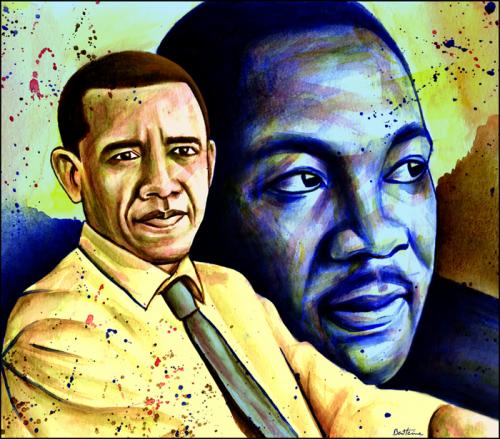
The other day Leigh pointed out how different the rhetoric has been in the past few days since Obama got elected with respect to his race. Before the election, people made passing references to the impact of electing the first African American president, but no one really got into the emotional aspect of it. Maybe that is because people were nervous to make too much of a big issue about his race before the election. Or maybe it was because they did not want to jinx his chances of winning.
But in the past few days there has been an outpouring of emotion about the momentous importance of Barack Obama’s election as the 44th President of the United States. It’s like we’ve been holding our breath for the past two years and simply cannot do it anymore so the words just spew out uncontrollably. I got pretty emotional during Barack Obama’s speech the other night. But I cannot imagine how poignant that moment must have been for people who lived through the Civil Rights era. And that cuts across racial lines. I think that it is just as important, though entirely different, for white people who experienced the racial turmoil of the 1960s, as it is for the black people who were consistently and sometimes violently suppressed.
Most of the texts that I have read regarding race relations in America have shared the same thesis: that whites inherited a position of power over those with darker skin and they are not willing to give it up. In The Fire Next Time, James Baldwin writes that waking up to a racially equal America would be the equivalent (for a white person) to opening your front door in the morning and seeing your entire world on fire. All of a sudden, what you thought was up was down, and what you thought was good was bad.
Though I think that holds true for much of America, I believe that white entitlement will start to fade with my generation and the next. A generation of children will grow up seeing Barack, Michelle, Sasha, and Malia Obama in the White House. For the next eight years, someone who would have been viciously oppressed as a slave two hundred years ago, will be the most powerful person in the world. The next two hundred years will reap the benefits of the fact that we are finally equal.
Eugene Robinson writes very eloquently on the importance of Barack Obama’s election. Here is an excerpt:
But in the past few days there has been an outpouring of emotion about the momentous importance of Barack Obama’s election as the 44th President of the United States. It’s like we’ve been holding our breath for the past two years and simply cannot do it anymore so the words just spew out uncontrollably. I got pretty emotional during Barack Obama’s speech the other night. But I cannot imagine how poignant that moment must have been for people who lived through the Civil Rights era. And that cuts across racial lines. I think that it is just as important, though entirely different, for white people who experienced the racial turmoil of the 1960s, as it is for the black people who were consistently and sometimes violently suppressed.
Most of the texts that I have read regarding race relations in America have shared the same thesis: that whites inherited a position of power over those with darker skin and they are not willing to give it up. In The Fire Next Time, James Baldwin writes that waking up to a racially equal America would be the equivalent (for a white person) to opening your front door in the morning and seeing your entire world on fire. All of a sudden, what you thought was up was down, and what you thought was good was bad.
Though I think that holds true for much of America, I believe that white entitlement will start to fade with my generation and the next. A generation of children will grow up seeing Barack, Michelle, Sasha, and Malia Obama in the White House. For the next eight years, someone who would have been viciously oppressed as a slave two hundred years ago, will be the most powerful person in the world. The next two hundred years will reap the benefits of the fact that we are finally equal.
Eugene Robinson writes very eloquently on the importance of Barack Obama’s election. Here is an excerpt:
I can't help but experience Obama's election as a gesture of recognition and acceptance -- which is patently absurd, if you think about it. The labor of black people made this great nation possible. Black people planted and tended the tobacco, indigo and cotton on which America's first great fortunes were built. Black people fought and died in every one of the nation's wars. Black people fought and died to secure our fundamental rights under the Constitution. We don't have to ask for anything from anybody.
Throw Palin Off a Train
NYTimes today on the infighting among the McCain campaign, specifically to Palin's odd "Rogue" behavior. I bet we will see a lot more of these kinds of articles. Also - Slate on what Palin should do next.
OTHER UPDATES
Because votes were slow to come in from Portland in the Oregon Senate race, it looks like the Democratic challenger Jeff Merkley has won, which raises the Democrats' lead to 57 seats.
There will probably be a special election in Alaska and Georgia to decide those senate seats. And a recount in Minnesota. So Dems have 57 seats with three still up for grabs. I'd say we will get one more.
OTHER UPDATES
Because votes were slow to come in from Portland in the Oregon Senate race, it looks like the Democratic challenger Jeff Merkley has won, which raises the Democrats' lead to 57 seats.
There will probably be a special election in Alaska and Georgia to decide those senate seats. And a recount in Minnesota. So Dems have 57 seats with three still up for grabs. I'd say we will get one more.
Transition Beginning

Well Barack Obama has already named his transition team, which will start to get the ball rolling on his cabinet and senior staff. I read somewhere that they were going to try and make most of those decisions by the middle of November. But it looks like it might get pushed back so that Barack can attend his grandmother's funeral and take some time off. So Those posts will probably be decided closer to Thanksgiving.
But Barack has already named Rahm Emanuel his White House Chief of Staff. It seems like a pretty good choice. From what I know about Emanuel (which is not much), he is a strategy guy and he has run the House congressional campaigns for the past few elections.
MSNBC and Bloomberg.com both have some pretty good articles about who Obama might choose for some important positions. HuffPost has an entire page dedicated to the transition choices. Obama will look to fill positions like Secretary of the Treasury (Lawrence Summers, Timothy Geithner, Warren Buffett), Secretary of Defense (Robert Gates, Chuck Hagel, Jack Reed), Secretary of State (Bill Richardson, John Kerry, Sam Nunn), and more. Expect to see a good number of Republican appointments. I am expected to be named the Secretary of Awesomeness.
UPDATE: Our field agent in Los Angeles Sarah Buchwalter has some more information about Rahm Emanuel: "It turns out that the character for Josh in the West Wing was inspired by Rahm. And Ari Gould from Entourage was inspired by Rahm's brother Ari who is a Hollywood agent."
Mandate?
The big question of the day is whether Barack Obama’s win and the widening Democratic majority in Congress indicates a progressive mandate. Remember that President Bush declared his 2004 win (with 286 electoral votes and a smaller popular vote) a mandate for his agenda. But the United States is generally considered a center-right country. So his agenda was already more appealing to many Americans than Obama's might be.
If the country truly remains more conservative than liberal, then Barack Obama will only hurt the Democrats in 2010 and 2012 if he governs aggressively as a liberal. But look at the election we just had. John McCain’s main argument against Barack Obama was that he was the most liberal Senator and some of his policies were socialist. And Obama won by one of the largest margins in the past half-century. So it looks like the country might be susceptible for a push towards the left.
John Judis of The New Republic writes today that the United States has, in fact, been moving left in the past fifty years. The size of each of the Democrats’ largest voting blocs, college-educated professionals, minorities, and women, is increasing, showing that there are simply more Democrats than there used to be. That could suggest that we are at the beginning of a long-term Democratic majority, both in the White House and in Congress. Judis points out more faults in thinking of the United States simply as a center-right nation:
But these things just go in cycles. Last night, the conservative CNN commentator Alex Castellanos spoke about how the Republicans swept into Washington in 1994 hoping to change the system. Instead of changing it, they began to embody Washington. That is why they were purged in 2006 and 2008. The same thing could happen to the Democrats in eight, twelve, or (fingers crossed) sixteen years.
All in all, I think last night was certainly a mandate. The Democrats have trounced Republicans in each of the last elections. And Barack Obama got elected saying that he would vastly expand health care, perpetuate the graduated tax system, and end the war in Iraq. The American people should expect that from him.
If the country truly remains more conservative than liberal, then Barack Obama will only hurt the Democrats in 2010 and 2012 if he governs aggressively as a liberal. But look at the election we just had. John McCain’s main argument against Barack Obama was that he was the most liberal Senator and some of his policies were socialist. And Obama won by one of the largest margins in the past half-century. So it looks like the country might be susceptible for a push towards the left.
John Judis of The New Republic writes today that the United States has, in fact, been moving left in the past fifty years. The size of each of the Democrats’ largest voting blocs, college-educated professionals, minorities, and women, is increasing, showing that there are simply more Democrats than there used to be. That could suggest that we are at the beginning of a long-term Democratic majority, both in the White House and in Congress. Judis points out more faults in thinking of the United States simply as a center-right nation:
These guys--and the others who are counseling Barack Obama and the Democrats to "go slow"--couldn't be more wrong. They are looking at Obama's election through the prism of Jimmy Carter's win in 1976 and Bill Clinton's victory in 1992. Both Carter and Clinton did misjudge the mood of the country. They tried unsuccessfully to govern a country from the center-left that was moving to the right (in Carter's case) or that was only just beginning to move leftward (in Clinton's case), and were rebuked by the voters. But Obama is taking office under dramatically different circumstances. His election is the culmination of a Democratic realignment that began in the '90s, was held in abeyance by September 11, and had resumed in the 2006 election.
But these things just go in cycles. Last night, the conservative CNN commentator Alex Castellanos spoke about how the Republicans swept into Washington in 1994 hoping to change the system. Instead of changing it, they began to embody Washington. That is why they were purged in 2006 and 2008. The same thing could happen to the Democrats in eight, twelve, or (fingers crossed) sixteen years.
All in all, I think last night was certainly a mandate. The Democrats have trounced Republicans in each of the last elections. And Barack Obama got elected saying that he would vastly expand health care, perpetuate the graduated tax system, and end the war in Iraq. The American people should expect that from him.
Senate Updates
It looks like there will be a December 2 runoff in Georgia between the incumbent Saxby Chambliss (R) and the challegner Jim Martin (D).
Also, expect a recount in the Minnesota race between incumbent Norm Coleman (R) and Al Franken (D).
The Dems currently have 56 seats in the senate for sure, but those races could add two more. I think that Chambliss is a lock for Georgia in the runoff because after the Obama win, Georgians might not want a huge democratic majority. But Minnesota could be interesting...
Also, expect a recount in the Minnesota race between incumbent Norm Coleman (R) and Al Franken (D).
The Dems currently have 56 seats in the senate for sure, but those races could add two more. I think that Chambliss is a lock for Georgia in the runoff because after the Obama win, Georgians might not want a huge democratic majority. But Minnesota could be interesting...
What Now?
There’s a great scene in the Robert Redford movie “The Candidate” when, after Redford’s character wins a Senate seat in a huge come-from-behind upset, he looks at his campaign manager, bewildered, and asks “Marvin, what do we do now?”
Well I’d guess that Barack is going to take a day or two off, bury his grandmother, and get started right away. He has already named Illinois congressman Rahm Emanuel his White House Chief of Staff. And in the next few days, we will see him naming more senior positions both on his staff and in his cabinet. I’ll try to stay on top of that and update here frequently about his major choices.
I want to point out for a second that the Democratic Senate hopes did not pan out as well as expected. It looks like they lost in Alaska, Minnesota, and probably Oregon as well. Still, they will control the Senate with at least 56 seats.
There are five major questions for the next few days and months.
1.) What will happen in North Carolina and Missouri? It looks like Barack will take NC and McCain will take MO, but keep an eye on it.
2.) Who will win the final Senate seats? The toss-ups, according to NYT, are Georgia, Oregon, and Alaska. The GOP candidate is leading in each of those elections.
3.) Who will President-elect Obama name for his cabinet and senior staff? Which posts will be filled by Republicans?
4.) Who will fill Barack Obama and Joe Biden’s seats in the US Senate? Jesse Jackson Jr. (congressman from Illinois) has been rumored for Obama’s seat, and Beau Biden (Joe’s son and Delaware Attorney General) has been suggested for Biden’s.
5.) Even though Stevens is probably going to keep his seat in Alaska, he will probably step down. That will allow the Governor of Alaska (Palin) to name his replacement until the 2010 midterm election. Who will she choose? My boss just predicted that she will step down and the Lt. Governor will appoint her. Senator Palin?
I’ll update later with some more stuff, and the winner for the electoral map contest when we see what happens in North Carolina and Missouri.
As for this blog, I’ll keep writing about politics here in the US and internationally. Barack Obama’s first order as President was to fund Projectile Politics. So I have hired four new reporters and we are opening offices in London, Hong Kong, Paris, and Accra. I am also accepting applications for the fall internship.
Well I’d guess that Barack is going to take a day or two off, bury his grandmother, and get started right away. He has already named Illinois congressman Rahm Emanuel his White House Chief of Staff. And in the next few days, we will see him naming more senior positions both on his staff and in his cabinet. I’ll try to stay on top of that and update here frequently about his major choices.
I want to point out for a second that the Democratic Senate hopes did not pan out as well as expected. It looks like they lost in Alaska, Minnesota, and probably Oregon as well. Still, they will control the Senate with at least 56 seats.
There are five major questions for the next few days and months.
1.) What will happen in North Carolina and Missouri? It looks like Barack will take NC and McCain will take MO, but keep an eye on it.
2.) Who will win the final Senate seats? The toss-ups, according to NYT, are Georgia, Oregon, and Alaska. The GOP candidate is leading in each of those elections.
3.) Who will President-elect Obama name for his cabinet and senior staff? Which posts will be filled by Republicans?
4.) Who will fill Barack Obama and Joe Biden’s seats in the US Senate? Jesse Jackson Jr. (congressman from Illinois) has been rumored for Obama’s seat, and Beau Biden (Joe’s son and Delaware Attorney General) has been suggested for Biden’s.
5.) Even though Stevens is probably going to keep his seat in Alaska, he will probably step down. That will allow the Governor of Alaska (Palin) to name his replacement until the 2010 midterm election. Who will she choose? My boss just predicted that she will step down and the Lt. Governor will appoint her. Senator Palin?
I’ll update later with some more stuff, and the winner for the electoral map contest when we see what happens in North Carolina and Missouri.
As for this blog, I’ll keep writing about politics here in the US and internationally. Barack Obama’s first order as President was to fund Projectile Politics. So I have hired four new reporters and we are opening offices in London, Hong Kong, Paris, and Accra. I am also accepting applications for the fall internship.

Fired Up
Watch this whole video.
Also from TPM, a pretty good breakdown of what to expect for tonight.
Also from TPM, a pretty good breakdown of what to expect for tonight.
The first key is Virginia at 7 PM. If Obama takes Virginia, where he's ahead, he'll almost certainly take Pennsylvania (at 8 PM) too. And that will pretty much be it for McCain. Between 6PM and 8 PM there are five other states: Indiana, Florida, Ohio, Missouri, North Carolina. These are all basically toss-ups with a few slight leads for Obama. If McCain is losing in any of them, he's probably done.


Senate Predictions
The world has been waiting for Ben Buchwalter’s 2008 Senate predictions. The world has to wait no longer. Here it is:
The Democrats will gain in Virginia, Alaska, Oregon, Minnesota, North Carolina, New Mexico, Colorado and New Hampshire. That will bring the total to 59 Democrats, and 41 Republicans. That includes the two independents who have caucused with the Democrats for the past two years, Bernie Sanders of Vermont and Joe Lieberman of Connecticut. But I think the Dems are going to cut Joe Lieberman loose due to his increasingly conservative agenda and support of John McCain in this election. I hope they don’t do that. I’m certainly not Lieberman’s biggest fan, but I don’t like the idea of the guy being blacklisted because he chose to cross the aisle.
Most likely, the Dems will not be able to get the magic majority of 60 votes to override a Republican filibuster. But its close enough so that the Democrats could do a lot of good in the next two years – especially if some Republicans are willing to cross the aisle from time to time. I think we will see this happen a lot as the country is shifting blue right now.
So I have Barack winning with 364 electoral votes, 59 Democratic senators, and a larger Democratic margin in the House of Representatives. I think it will be better than the average Tuesday.
The Democrats will gain in Virginia, Alaska, Oregon, Minnesota, North Carolina, New Mexico, Colorado and New Hampshire. That will bring the total to 59 Democrats, and 41 Republicans. That includes the two independents who have caucused with the Democrats for the past two years, Bernie Sanders of Vermont and Joe Lieberman of Connecticut. But I think the Dems are going to cut Joe Lieberman loose due to his increasingly conservative agenda and support of John McCain in this election. I hope they don’t do that. I’m certainly not Lieberman’s biggest fan, but I don’t like the idea of the guy being blacklisted because he chose to cross the aisle.
Most likely, the Dems will not be able to get the magic majority of 60 votes to override a Republican filibuster. But its close enough so that the Democrats could do a lot of good in the next two years – especially if some Republicans are willing to cross the aisle from time to time. I think we will see this happen a lot as the country is shifting blue right now.
So I have Barack winning with 364 electoral votes, 59 Democratic senators, and a larger Democratic margin in the House of Representatives. I think it will be better than the average Tuesday.
Electoral College Woes
 This weekend, the New York Times published the map above, which shows the size of each state proportional to the power of one vote. In the electoral college system, a state cannot have fewer than three electoral votes, regardless of how small its population. As a result, one vote in the states with very small populations (Wyoming, North Dakota etc...) is worth more than a vote in states with larger popultions (California, New York etc...).
This is just another reason that the Electoral College system is outdated and should be disbanded. As I understand it, the system exists so that the electors can correct the popular choice if they think that it was wrongly decided. As far as I know, electors almost never vote differently than the area they are responsible for. If this were ever to happen, the electors should have switched the decision in 2000 based on the fact that Al Gore won the popular vote. But alas, we are in George Bush's America eight years later.
Also, wouldn't it be great if candidates campaigned for votes rather than states? By visiting states like Alabama and Kentucky, Democrats might be able to persuade some voters there that they have been Democrats this whole time without even knowing it. They had just never seen one in real life to make that clear.
There are so many benefits to disbanding the Electoral College system. But the most important is the fact that without the Electoral College, we can achieve the pure democracy that we seem to be so proud of.
Polls! 2 days! Hullabaloo!
So when on Tuesday are we going to know? Lets start with the numbers.
According to Politico, there are 18 states, totaling 234 electoral votes that will definitely go for Obama or are leaning in his direction. There are 19 states totaling 150 electoral votes that will definitely go for McCain. That means that Obama only needs 36 extra electoral votes from the remaining 13 swing states to win the election. Those states are listed below with their electoral vote value. The ones in blue are slightly leaning Obama, those in red are leaning McCain.
Total electoral votes in swing states: 134
Nevada (5)
New Mexico (5)
Colorado (9)
Pennsylvania (21)
Ohio (20)
Florida (27)
Virginia (13)
North Carolina (15)
New Hampshire (4)
Mossouri (11)
Indiana (11)
Arizona (10)
North Dakota (3)
If you just look at the swing states in which Obama is ahead by at least five points according to the most recent poll in that state (NM, CO, PA, OH, NH), then Barack Obama would win with at least 293 electoral votes with 75 electoral votes in swing states still up for grabs. If Obama sweeps the swing states in which he is ahead, then he would win with 353 electoral votes. This is unlikely to happen because it actually does seem like the race is getting closer in states like Virginia, North Carolina and Nevada.
So when will we know who won? To get those 36 votes that Barack Obama needs to win, I think that his bare bones best chances are winning Pennsylvania (21) and Ohio (20) to put him over the top. Polls close in Ohio at 7:30 ET and in Pennsylvania at 8:00 ET. So I am going to go ahead and predict that we will know the winner by 9:30 Eastern Time on Tuesday night. Of course, that estimate is dependent on how close things actually are in those states, and when the major cities (Philadelphia, Pittsburgh, Columbus, Cleveland, Cincinnati) are counted.
Get excited.
According to Politico, there are 18 states, totaling 234 electoral votes that will definitely go for Obama or are leaning in his direction. There are 19 states totaling 150 electoral votes that will definitely go for McCain. That means that Obama only needs 36 extra electoral votes from the remaining 13 swing states to win the election. Those states are listed below with their electoral vote value. The ones in blue are slightly leaning Obama, those in red are leaning McCain.
Total electoral votes in swing states: 134
Nevada (5)
New Mexico (5)
Colorado (9)
Pennsylvania (21)
Ohio (20)
Florida (27)
Virginia (13)
North Carolina (15)
New Hampshire (4)
Mossouri (11)
Indiana (11)
Arizona (10)
North Dakota (3)
If you just look at the swing states in which Obama is ahead by at least five points according to the most recent poll in that state (NM, CO, PA, OH, NH), then Barack Obama would win with at least 293 electoral votes with 75 electoral votes in swing states still up for grabs. If Obama sweeps the swing states in which he is ahead, then he would win with 353 electoral votes. This is unlikely to happen because it actually does seem like the race is getting closer in states like Virginia, North Carolina and Nevada.
So when will we know who won? To get those 36 votes that Barack Obama needs to win, I think that his bare bones best chances are winning Pennsylvania (21) and Ohio (20) to put him over the top. Polls close in Ohio at 7:30 ET and in Pennsylvania at 8:00 ET. So I am going to go ahead and predict that we will know the winner by 9:30 Eastern Time on Tuesday night. Of course, that estimate is dependent on how close things actually are in those states, and when the major cities (Philadelphia, Pittsburgh, Columbus, Cleveland, Cincinnati) are counted.
Get excited.

Subscribe to:
Posts (Atom)
.jpg)