The Washington Post reports today that the government of Sudan is uncomfortable with Barack Obama's agressive opposition to genocide. A quote from Ghazi Suleiman, a member of the Southern People's Liberation Movement, which has a power-sharing agreement with Sudan's ruling party: "I think we really will miss the judgments of George W. Bush."
That says more about Bush than Suleiman or Sudan.
Barack Obama and Joe Biden have both spoken about the need for a larger international presence in cases of genocide. And they are expected tofollow the advice of many advisors and reports that urge more involvement in humanitarian issues throughout the world.
And Susan E. Rice, Obama's choice for Ambassador to the United Nations, is an ouspoken proponent of U.S. intervention in genocides.

Elections in Ghana are Prize for Democracy

Today nearly half of Ghana's population is expected to vote on who succeeds President John Kufour, who has led the country for eight years, the maximum length allowed according to Ghana's constitution. Though Ghana was the first African nation to declare independence from European colonization, it endured decades of military and dictatorial leadership.
Before Kufour was elected, the military leader J.J. Rawlings ruled the country from 1981 through 2001. He first overthrew the government in 1979 to rid it of corruption and try to re-implement a democratic system. But Dr. Hilla Limann, who was elected after this coup, soon defaulted to the corruption that was traditionally part of Ghanaian politics. This led to Rawlings' second military coup in 1981. For the next twelve years, Rawlings ruled the country as the Chairman of the Provisional National Defense Council (PNDC). In his second decade, Rawlings changed his title to "President" and was elected through a series of less-than-legitimate elections. John Kufour was elected in Democratic elections in 2001. Click here for a timeline.
So Kufour's decision to step down after two terms serving as President indicates Ghana's incredible transformation and status as a Democratic power in Africa. The election, between Kufour's chosen successor Nana Akufo-Addo of the NPP and John Atta Mills of Rawlings' Party, the NDC, is likely to run smoothly without the electoral corruption that has plagued elections and led to politically-charged violence in some African countries including Nigeria, Kenya, and Zimbabwe.
I spent four months studying abroad in Ghana in the Spring of 2007. The photo above is from the celebration of the 50th anniversary of Ghana's independence from British rule. Though Rawlings is still a force in Ghanaian politics, a relapse to electoral fraud and political manipulation of the population seems seriously unlikely. From what I could tell, Ghanaians are extremely proud of their status as one of the world's solid Democracies. Hopefully that status will be maintained by a successful transfer of power after today's election.
Are Liberals Really Enraged?
In the past few weeks, there has been considerable discussion surrounding liberal anger about Obama’s early cabinet choices. Pundits are falling all over themselves to get liberals to say that they feel abandoned by this apparent move to the center. This issue is largely born from three symptoms:
1) There are many liberals who are truly and legitimately frustrated with Obama's choices,
2) The media’s overwhelming urge to create controversy,
3) The Republican Party’s insistence they are not failing and that Obama must complement his Presidency with a constant string of centrist policies.
A Wall Street Journal article today argues the following: “Having enraged the left wing of his party with several initial high-profile appointments, Mr. Obama is now under pressure to placate this mob. One obvious, if frightening, choice would be to reward them with the energy-and-environment portfolio, turning it over to a team that shares the grass-roots' green agenda.”
First of all, this overstates the disappointment that the Left has had with Obama’s initial appointments. A Gallup Poll released today finds that 65% of liberals are still supportive of President-elect Obama. And even for those who are less-than-pleased, this is frustration, not rage. And I think that his early picks have been politically essential to improve his mandate and have a more widespread impact when he is inaugurated on January 20. Also, if Obama begins to appoint more liberal Cabinet members, it will be because they are the best candidates for those jobs, not to “placate this mob” of blood-thirsty-centrist-hating-socialist crazies.
Second, these early Cabinet choices are in departments that one might expect a liberal President to make more centrist choices by default: foreign relations and the economy. All throughout the Primary, Barack Obama promised to "gather up talent from everywhere." (I also want to note that his choice for Ambassador to the U.N., Susan E. Rice, is a strong progressive who seems eager to reject the policies of the Bush Administration.)
But Obama still has many cabinet positions to fill, and these are primarily areas in which he is likely to go liberal. These include Secretary of the Interior, Secretary of Education, and head of the EPA. And an openly gay woman - Mary Beth Maxwell - is being seriously considered for Secretary of Labor.
And above all this, I believe in the argument that all of these Secretaries are Obama’s employees. At the end of the day, regardless of their own ideology, they will implement Obama’s policies.
So before we liberals freak out about Obama’s departure from the left, and before conservatives declare victory in this ongoing ideological war, let’s remember that we are barely beginning the first quarter of a long, eight year Obama Presidency. Sure, Obama is likely to be more centrist than a lot of us would like, but let’s keep the hope alive that he will deliver on that oft-cited message of change.
1) There are many liberals who are truly and legitimately frustrated with Obama's choices,
2) The media’s overwhelming urge to create controversy,
3) The Republican Party’s insistence they are not failing and that Obama must complement his Presidency with a constant string of centrist policies.
A Wall Street Journal article today argues the following: “Having enraged the left wing of his party with several initial high-profile appointments, Mr. Obama is now under pressure to placate this mob. One obvious, if frightening, choice would be to reward them with the energy-and-environment portfolio, turning it over to a team that shares the grass-roots' green agenda.”
First of all, this overstates the disappointment that the Left has had with Obama’s initial appointments. A Gallup Poll released today finds that 65% of liberals are still supportive of President-elect Obama. And even for those who are less-than-pleased, this is frustration, not rage. And I think that his early picks have been politically essential to improve his mandate and have a more widespread impact when he is inaugurated on January 20. Also, if Obama begins to appoint more liberal Cabinet members, it will be because they are the best candidates for those jobs, not to “placate this mob” of blood-thirsty-centrist-hating-socialist crazies.
Second, these early Cabinet choices are in departments that one might expect a liberal President to make more centrist choices by default: foreign relations and the economy. All throughout the Primary, Barack Obama promised to "gather up talent from everywhere." (I also want to note that his choice for Ambassador to the U.N., Susan E. Rice, is a strong progressive who seems eager to reject the policies of the Bush Administration.)
But Obama still has many cabinet positions to fill, and these are primarily areas in which he is likely to go liberal. These include Secretary of the Interior, Secretary of Education, and head of the EPA. And an openly gay woman - Mary Beth Maxwell - is being seriously considered for Secretary of Labor.
And above all this, I believe in the argument that all of these Secretaries are Obama’s employees. At the end of the day, regardless of their own ideology, they will implement Obama’s policies.
So before we liberals freak out about Obama’s departure from the left, and before conservatives declare victory in this ongoing ideological war, let’s remember that we are barely beginning the first quarter of a long, eight year Obama Presidency. Sure, Obama is likely to be more centrist than a lot of us would like, but let’s keep the hope alive that he will deliver on that oft-cited message of change.
Anti-Zionism = Anti-Semitism?
Interesting article in Forbes about veiled anti-semetism in the United Nations.
When people criticize Zionists, they mean Jews. You are talking anti-Semitism. --The Rev. Martin Luther King, 1968
Matthews to Leave MSNBC?
MSNBC suggested yesterday that Chris Matthews, the host of MSNBC’s Hardball with Chris Matthews, should resign from the show if he intends to run for U.S. Senate in Pennsylvania to out seat Republican Arlen Specter, as rumors suggest that he will.
Matthews recently denied his interest in the Senate seat after it was reported that he spoke to officials from the Pennsylvania Democratic Party about strategy.
His celebrity could be a plus or a minus. It would benefit him because he has much more pre-election exposure to voters than an unknown or local leader would. But it could, as former Democratic Congressman Joe Hoeffel suggested, make him seem “out of touch with the state.”
Either way, it would be a tough fight for Matthews. According to a recent Quinnipiac poll, he trails Specter by 12 points. But that is before he has even announced his candidacy, and 60% of likely voters said that they did not have enough information to make a firm choice. And a brand new Ramussen poll shows Matthews behind by only three points. And Kleefeld says that most of the undecideds in this poll would likely "end up breaking to Matthews as the Dem nominee."
Matthews’ most difficult obstacle might come in the Democratic Primary. Other potential candidates to challenge Specter are Rep. Allyson Schwartz and state Rep. Josh Shapiro, both from Montgomery County, and Rep. Joe Sestak, from Delaware County.
If Matthews emerges from the primary the victor, then I think he would be an exciting and charged candidate to take on Arlen Specter. So stay tuned to see whether he resigns, or if this is simply a bargaining tool to get a better contract from MSNBC when his contract expires next June.
Here's David Sirota of OpenLeft on why Chris Matthews would be an awful addition to the U.S. Senate.
Matthews recently denied his interest in the Senate seat after it was reported that he spoke to officials from the Pennsylvania Democratic Party about strategy.
His celebrity could be a plus or a minus. It would benefit him because he has much more pre-election exposure to voters than an unknown or local leader would. But it could, as former Democratic Congressman Joe Hoeffel suggested, make him seem “out of touch with the state.”
Either way, it would be a tough fight for Matthews. According to a recent Quinnipiac poll, he trails Specter by 12 points. But that is before he has even announced his candidacy, and 60% of likely voters said that they did not have enough information to make a firm choice. And a brand new Ramussen poll shows Matthews behind by only three points. And Kleefeld says that most of the undecideds in this poll would likely "end up breaking to Matthews as the Dem nominee."
Matthews’ most difficult obstacle might come in the Democratic Primary. Other potential candidates to challenge Specter are Rep. Allyson Schwartz and state Rep. Josh Shapiro, both from Montgomery County, and Rep. Joe Sestak, from Delaware County.
If Matthews emerges from the primary the victor, then I think he would be an exciting and charged candidate to take on Arlen Specter. So stay tuned to see whether he resigns, or if this is simply a bargaining tool to get a better contract from MSNBC when his contract expires next June.
Here's David Sirota of OpenLeft on why Chris Matthews would be an awful addition to the U.S. Senate.
Oh Well
Incumbent Saxby Chambliss has won the Senate runoff in Georgia. It’s now clear that the Democrats are not going to attain that 60 seat majority necessary to stop a Republican filibuster. But really, that was unlikely to happen anyway. On November 5, Saxby Chambliss got about 49.8% of the vote, when 50% was needed to prevent a runoff . And Chambliss’ opponent, Jim Martin, had a lot going against him. First of all, he lost the election. Second, Obama’s win and the large Democratic gains in the House and Senate must have prompted conservatives and independents to flock to Chambliss to check the Democrat’s power.
All eyes now turn to the Minnesota recount between Al Franken and incumbent Norm Coleman. Recent numbers show Franken down by fewer than 50 votes, and that number keeps decreasing. I don’t know when they will finally call this recount, but the longer it goes, the better it looks for the Democrats and the chances of attaining a 59 seat majority.
All eyes now turn to the Minnesota recount between Al Franken and incumbent Norm Coleman. Recent numbers show Franken down by fewer than 50 votes, and that number keeps decreasing. I don’t know when they will finally call this recount, but the longer it goes, the better it looks for the Democrats and the chances of attaining a 59 seat majority.
Philadelphia Governor’s Meeting “Very Productive”

President-elect Obama met with 48 members of the National Governors Association today to talk about the economic stimulus plan that President Obama hopes to sign into effect when he is inaugurated on January 20, 2009.
Pennsylvania Governor Ed Rendell said “this is the best of all the financial recovery plans [because] all of the previous bailouts don’t do one thing to create one new job.”
Obama was also careful to strike a bi-partisan tone: "There is a time for campaigning, and there is a time for governing," he said. "And one of the messages that Joe and I want to continually send is that we are not going to be hampered by ideology in trying to get this country back on track."
Since 41 States are experiencing budget shortfalls for next year, their involvement in the stimulus plan was essential. But Philadelphia Mayor Michael Nutter worried that Obama would forget the importance of cities. "We’re at the ground level. We fill potholes, we pick up trash....It is literally where the rubber meets the road. We just want to make sure there is federal support for us as well." Nutter, who is slashing next year’s budget because of an unexpected deficit, recently wrote to Treasury Secretary Hank Paulson asking for Federal support.
Pennsylvania Governor Ed Rendell said “this is the best of all the financial recovery plans [because] all of the previous bailouts don’t do one thing to create one new job.”
Obama was also careful to strike a bi-partisan tone: "There is a time for campaigning, and there is a time for governing," he said. "And one of the messages that Joe and I want to continually send is that we are not going to be hampered by ideology in trying to get this country back on track."
Since 41 States are experiencing budget shortfalls for next year, their involvement in the stimulus plan was essential. But Philadelphia Mayor Michael Nutter worried that Obama would forget the importance of cities. "We’re at the ground level. We fill potholes, we pick up trash....It is literally where the rubber meets the road. We just want to make sure there is federal support for us as well." Nutter, who is slashing next year’s budget because of an unexpected deficit, recently wrote to Treasury Secretary Hank Paulson asking for Federal support.
VP Calls for Rail Transit
Yglesias brings up a good point about today’s Governor’s Association meeting in Philadelphia. Biden issued a speech laying out some reasons that we should promote public transportation, specifically rail transit. Focusing Obama’s stated desire to promote public works projects on public transportation would be incredibly smart. There are still many American cities that have sub-par transportation systems within the city and almost non-existent rail options from the ‘burbs.
Jumpstarting a massive rail construction program would kill many birds with one giant, expensive stone. It would prompt suburbanites who live outside the city to visit and spend on urban businesses and entertainment; it would provide cheap, public transportation for urban workers who live outside the city; and most importantly, it would drastically reduce the number of people who commute in personal vehicles, and thereby benefit our degraded, asthma-ridden natural environment.
Seattle is a good example of the need for more rail-centric public transportation. Within the city, it is fairly easy to get around using the bus system. But there is no rail transit besides the monorail that goes about three blocks and was created as spectacle for the World’s Fair in 1962.
But a Light Rail will be completed next year to transport people from SeaTac airport to downtown Seattle and back. I’m very glad that this is happening, but its impact will not reach its potential unless complemented by a more extensive rail program becuase traffic west into Seattle from the Eastside is awful for hours every morning and evening. And the same goes for along I-5 north of the city center. Both are areas that the Light Rail will not service.
Biden’s suggestion for developing more rail transit would help cities like Seattle develop their rail programs to benefit workers, drivers, and the environment.
Terrorism and the Cabinet
In a Washington Post column today, Eugene Robinson discusses threats of terrorism in relation to Obama’s newly-announced-but-unsurprising foreign policy team. When asked about the terrorist attacks in India, which many believe were supported by Pakistan, Obama promised to fight “those who kill innocent individuals to advance hateful extremism.” Robinson asks whether this is actually the definition of terrorism.
I think George and I were talking about this the other day. Is terrorism necessarily connected to an ideological objective? Or is terrorism more generally defined as a violent act to destabilize an established group and kill innocent people? My initial reaction was that terrorism is traditionally general, encompassing those who kill for a cause and those who kill for no reason. In its modern form, though, terrorism definitely refers to ideologically-based carnage.
So what do Obama’s choices for his foreign policy team suggest about his stance on terrorism? Well, it’s an interesting team. There was considerable debate among liberals about whether keeping Robert Gates as Secretary as Defense was a good choice. I would have been happier with someone else, but I see the political necessity to keeping a Republican in that position and having continuity in our wars as we get a new Commander in Chief.
Also, I think that the best way for the U.S. to protect itself against terror is to drastically change its perception in the world and that means engaging in constructive discussions with our foes. Steve Clemons writes that Gates could be a productive voice in making this happen.
And the choice of General James L. Jones as National Security Advisor once again shows that Obama values a Cabinet with experience to implement his vision. General Jones is a retired Marine and former NATO commander. In recent months, Jones has criticized the war in Iraq because it forced the U.S. to “take its eye off the ball” in Afghanistan, which he sees as the central front in the war on terror. Jones also views reducing our dependence on foreign energy as central to decreasing the risk of future terrorism.
Obama’s choices for top foreign policy positions are very interesting, though not progressive. But if he’s going to choose a department in which to flex his bipartisan muscles, then the Department of Defense is a pretty good choice. And Gates and Jones are not your typical Rumsfeldian Defense Department ideologues.
I think George and I were talking about this the other day. Is terrorism necessarily connected to an ideological objective? Or is terrorism more generally defined as a violent act to destabilize an established group and kill innocent people? My initial reaction was that terrorism is traditionally general, encompassing those who kill for a cause and those who kill for no reason. In its modern form, though, terrorism definitely refers to ideologically-based carnage.
So what do Obama’s choices for his foreign policy team suggest about his stance on terrorism? Well, it’s an interesting team. There was considerable debate among liberals about whether keeping Robert Gates as Secretary as Defense was a good choice. I would have been happier with someone else, but I see the political necessity to keeping a Republican in that position and having continuity in our wars as we get a new Commander in Chief.
Also, I think that the best way for the U.S. to protect itself against terror is to drastically change its perception in the world and that means engaging in constructive discussions with our foes. Steve Clemons writes that Gates could be a productive voice in making this happen.
He wants to try and push Iran-US relations into a constructive direction. He wants to change the game in Afghanistan -- and the answer will not be a military-dominant strategy. He wants to try and stabilize Iraq in a negotiated, confidence building process that includes Saudi Arabia, Iran, Turkey and other regional forces. And he wants to support a big push on Israel-Palestine peace and reconfigure relations between much of the Arab League and Israel.
And the choice of General James L. Jones as National Security Advisor once again shows that Obama values a Cabinet with experience to implement his vision. General Jones is a retired Marine and former NATO commander. In recent months, Jones has criticized the war in Iraq because it forced the U.S. to “take its eye off the ball” in Afghanistan, which he sees as the central front in the war on terror. Jones also views reducing our dependence on foreign energy as central to decreasing the risk of future terrorism.
Obama’s choices for top foreign policy positions are very interesting, though not progressive. But if he’s going to choose a department in which to flex his bipartisan muscles, then the Department of Defense is a pretty good choice. And Gates and Jones are not your typical Rumsfeldian Defense Department ideologues.
Pinch Me - I Love Susan E. Rice
This morning President-elect Obama named Susan E. Rice, a proponent of military force to combat genocide, his choice for the Cabinet position of Ambassador to the United Nations. This sends an incredible message that the Obama administration will restore one of the most important aspects of American moral superiority: helping other nations even when there is no political profit. Of course, we should not intervene in all cases, but I think we must when it comes to genocide.
We said “never again” after the genocide in Germany. We said “never again” after the genocide in Yugoslavia. We said “never again” after the genocide in Rwanda. And we said nothing during the genocide in Sudan.
The choice of Rice as ambassador to the United Nations sends a clear message that the U.S. (or at least the Obama administration) will never again neglect to respond to an international genocide.
In her own words after visiting post-genocide Rwanda: "I swore to myself that if I ever faced such a crisis again, I would come down on the side of dramatic action, going down in flames if that was required."
Obama also named Hillary Clinton Secretary of State, General James Jones as National Security Advisor, Eric Holder as Attorney General and Janet Napolitano as Secretary of Homeland Security. Robert Gates, appointed by Bush, will stay on as Secretary of Defense.
We said “never again” after the genocide in Germany. We said “never again” after the genocide in Yugoslavia. We said “never again” after the genocide in Rwanda. And we said nothing during the genocide in Sudan.
The choice of Rice as ambassador to the United Nations sends a clear message that the U.S. (or at least the Obama administration) will never again neglect to respond to an international genocide.
In her own words after visiting post-genocide Rwanda: "I swore to myself that if I ever faced such a crisis again, I would come down on the side of dramatic action, going down in flames if that was required."
Obama also named Hillary Clinton Secretary of State, General James Jones as National Security Advisor, Eric Holder as Attorney General and Janet Napolitano as Secretary of Homeland Security. Robert Gates, appointed by Bush, will stay on as Secretary of Defense.
Matthews Denies 2010 Senate Run

This week, the MSNBC political commentator and host of Hardball with Chris Matthews and The Chris Matthews show, Chris Matthews, denied a report by FiveThirtyEight that he was meeting with Obama campaign operatives about staffing his rumored 2010 Senate campaign to unseat Pennsylvania Republican Arlen Specter.
It is still unclear how Matthews would do against the moderate Republican. A Quinnipiac poll released last week showed Matthews trialing by twelve points, with 60% of voters saying that they don’t know enough about Matthews to make an informed decision at this time. Philadelphia is the only region in which Matthews currently leads. But Matthews could be a formidable opponent. He worked as a top aide to former Speaker of the House Tip O’Neill and a presidential speech writer for Jimmy Carter. Add that to Obama’s political machine, and I think you’ve got a pretty good candidate.
It is still unclear how Matthews would do against the moderate Republican. A Quinnipiac poll released last week showed Matthews trialing by twelve points, with 60% of voters saying that they don’t know enough about Matthews to make an informed decision at this time. Philadelphia is the only region in which Matthews currently leads. But Matthews could be a formidable opponent. He worked as a top aide to former Speaker of the House Tip O’Neill and a presidential speech writer for Jimmy Carter. Add that to Obama’s political machine, and I think you’ve got a pretty good candidate.
300 Dead in Nigerian Riots...
And this article is buried low on the New York Times homepage. This weekend's horrifying terrorist attacks in India received appropriate media coverage. Why is an Indian life more significant than a Nigerian life?
Here is a pretty good article with video on BBC.
CNN
Washington Post
More on this later this week.
Here is a pretty good article with video on BBC.
CNN
Washington Post
More on this later this week.
Is Africa African?
Ezra Klein asks whether we should refer to African countries as "African." The basic arguments are as follows.
So I don't think that we should unilaterally say that the "African" connection should be used or avoided. But I think that we need to be careful about how we talk about African countries on a cas-by-case basis.
- It is ridiculous to refer to all countries on the continent as similar. The continent is infinitely larger than the United States, and we barely speak of people from California and Oregon as the same nationality. Referring to it all as "Africa" instead of the name of the specific country being discussed reinforces the idea of Africa as the Dark Continent, a large mass of indistinguishable land.
- There is a really powerful connection to be drawn between the African countries. Even though each has its own distinct history, countries as diverse as Ghana, South Africa, Rwanda and the Democratic Republic of the Congo have a similar post-colonial identity because of the shared legacy of European colonization. Speaking about "Africa" is useful to study this connection.
So I don't think that we should unilaterally say that the "African" connection should be used or avoided. But I think that we need to be careful about how we talk about African countries on a cas-by-case basis.
Happy Thanksgiving!
Sorry for the previous downer of a post. Really, I love Thanksgiving. Like many things American, its got a shady past, but thats what is so encouraging about all things American. We've still got a long way to go to live up to the potential for American greatness. And I sincerely hope that we will reach such greatness during my lifetime.
ThinkProgress has a pretty good list of things they are thankful for. Some of those are provided below.
ThinkProgress has a pretty good list of things they are thankful for. Some of those are provided below.
We’re thankful we’ll soon have a president who will hit the ground running instead of a president who is running the country into the ground.
We’re thankful Sarah Palin has more time to watch over Russia and warn us in case Vladimir Putin ever “rears his head.”
We’re thankful that we’re moving closer towards a complete withdrawal from Iraq.
We’re thankful for the thousands of protesters who took to the streets across America to push for marriage equality.
We’re not thankful for neo-McCarthys, neo-Hoovers, neo-Nazis, and neocons.
We’re thankful for Tina Fey.
We’re thankful to be liberal hacks.
We’re thankful that our troops will be able to get the education they so richly deserve.
We’re thankful that reality still has a liberal bias.
We’re thankful that there are only 54 days left until the end of the George W. Bush presidency.
We’re thankful for the progressive mandate to govern.
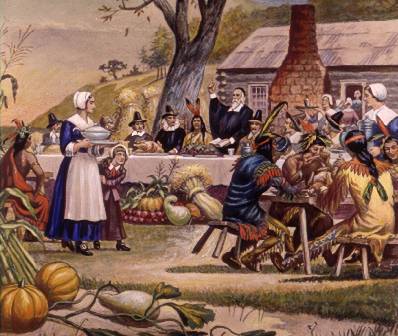
What, to the Native American, is Thanksgiving?
In 1852, Frederick Douglas was asked to speak at a convention in Rochester, NY to commemorate the 4th of July. At this point, the ownership and mistreatment of slaves was still accepted throughout the United States.
Douglass’ speech, “What to the American Slave, is the 4th of July” was a brief but well-reasoned rebuke against the (lack of) logic of asking him to speak. Pointing out the hypocrisy of American independence day, Douglass said:
Your high independence only reveals the immeasurable distance between us. The blessings in which you, this day, rejoice are not enjoyed in common. The rich inheritance of justice, liberty, prosperity, and independence bequeathed by your fathers is shared by you, not by me. The sunlight that brought light and healing to you has brought stripes and death to me. This Fourth of July is yours, not mine.
I wonder if Native Americans feel the same way about Thanksgiving. The revisionist history of Thanksgiving is that we Europeans jumped off the boat and were graciously welcomed by America’s original inhabitants so everyone shared a massive feast to commemorate their great partnership in this great country.
We now know that this story is entirely false. In reality, Europeans stole their land, and massacred the vast majority of the Native American population. The discrimination of America’s native population was official government policy for the vast majority of our history, just as slavery and racial segregation was official U.S. policy for more than two hundred years. And we have yet to repent properly.
So what, to the Native American, is Thanksgiving? It is a farce that highlights the government’s selective amnesia in its darkest hours. It is a mockery of the beautiful and well-maintained land that was stolen in return for the dusty reservations that white people did not want.
Thanksgiving should make us think about what we are thankful for. But it should also make us think about our failings and how we can improve upon them. And I would like to see a more whole-hearted attempt by the United States government to apologize for its original sins of slavery and Native American relocation, even if this attempt is only in the form of words.
That would finally make days like the 4th of July and Thanksgiving fully inclusive holidays that represent national cohesion rather than ignore past oppression.
Subscribe to:
Posts (Atom)
.jpg)